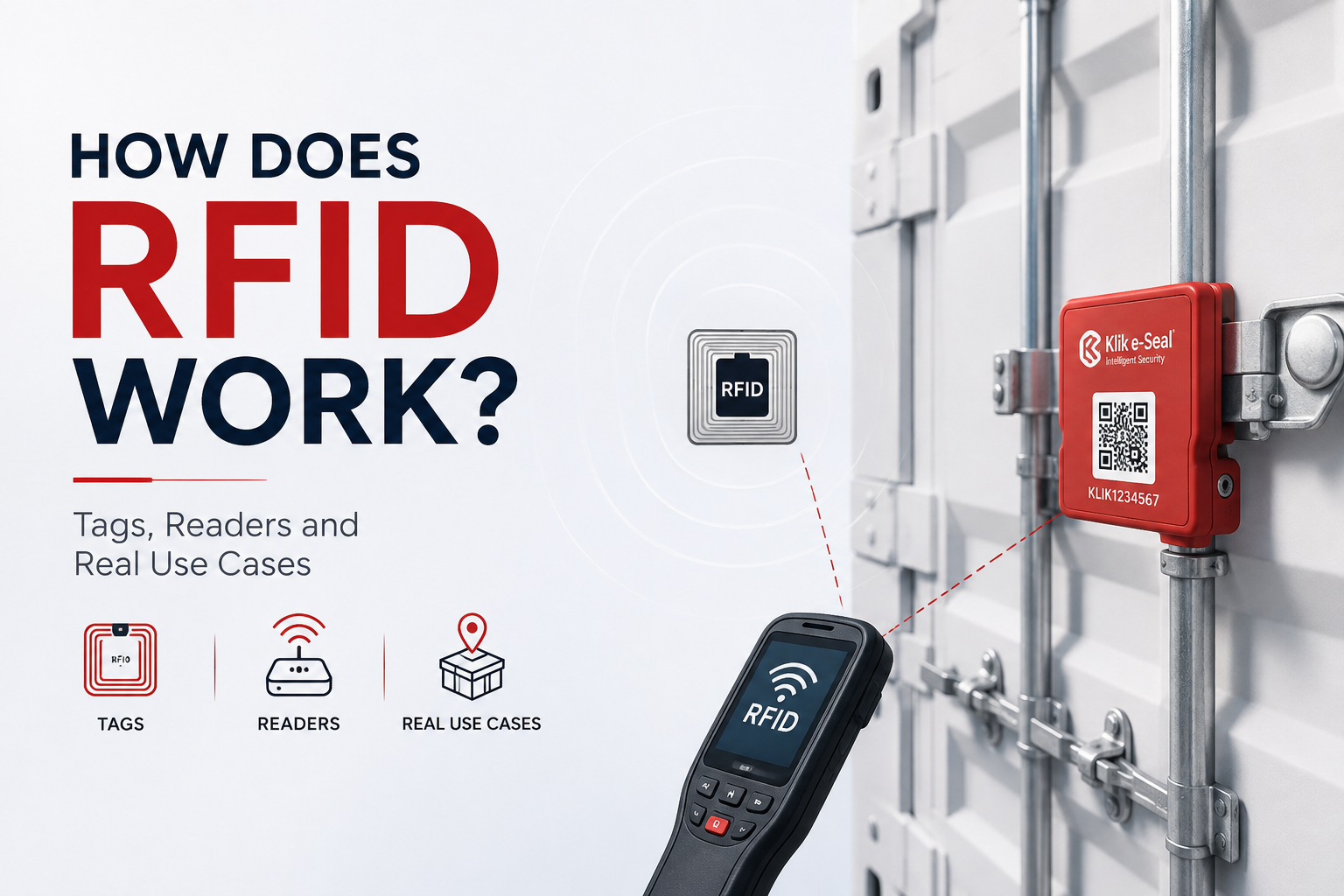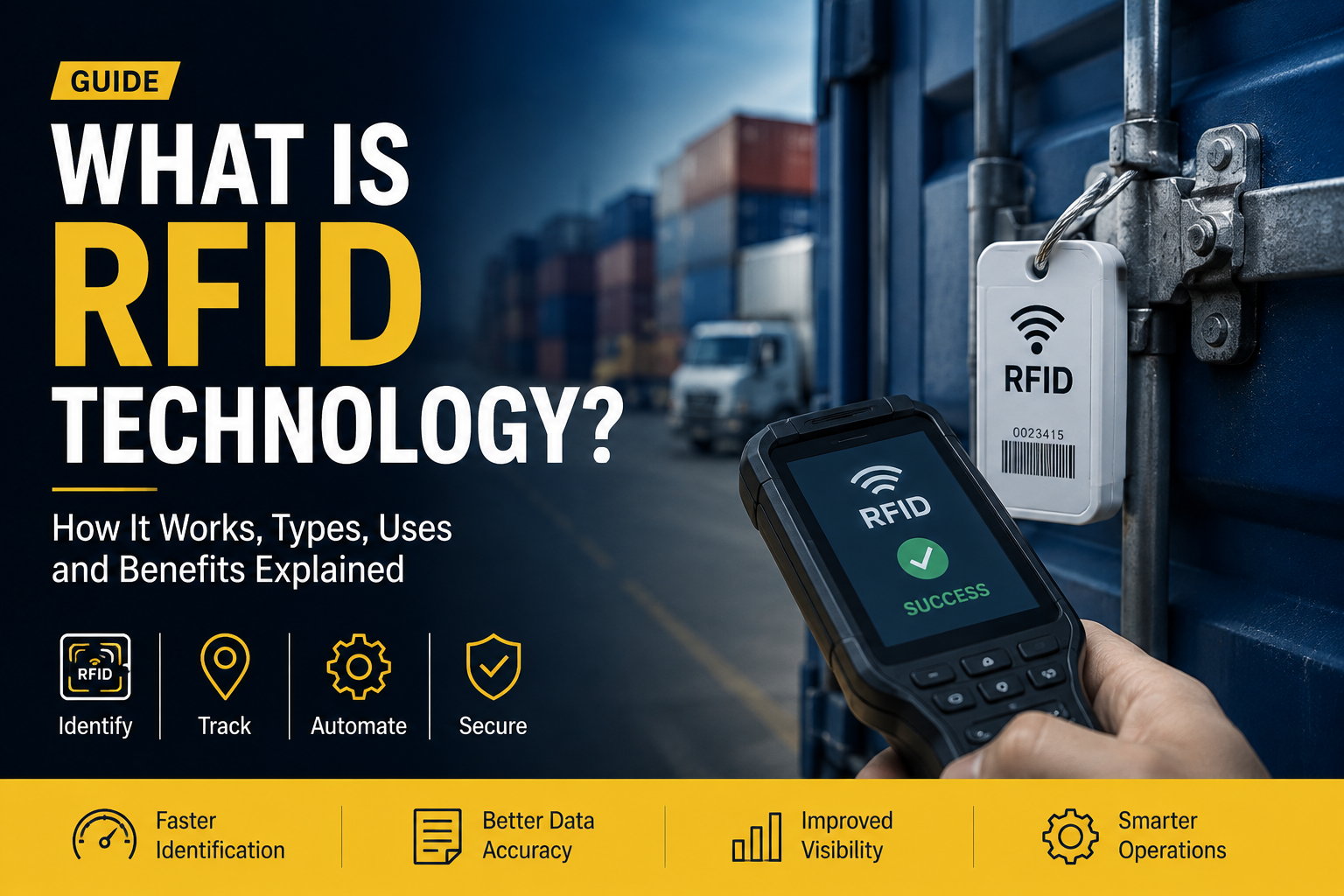

RFID, or Radio Frequency Identification, is a technology that uses radio waves to automatically identify and track objects through electronic tags and readers. Unlike barcodes, RFID does not always require direct line of sight, allowing multiple tagged objects to be identified quickly and automatically.
From warehouse inventory to supply chain tracking and electronic seals, RFID connects physical objects with digital information. But how does it actually work, and where does it make sense to use it?
How Does RFID Technology Work?
An RFID system is built around a simple interaction:
RFID tag → RFID reader → software → stored or processed data
The tag carries identification information. The reader communicates with the tag using radio waves and captures that information. Software can then use the captured data to record an event, update inventory, verify an asset, or trigger another action.
Here are the main components of a standard system:
1. RFID Tag
An RFID tag usually contains a microchip and an antenna. The chip stores identification information, while the antenna allows the tag to communicate with the reader. The tag is attached to the object being identified. Depending on the application, it could be placed on a product, pallet, vehicle, asset, document, or electronic seal.
2. RFID Reader
The RFID reader sends a radio signal and receives the response from the tag. Readers can be fixed in a specific location or used as handheld devices. A fixed reader, for example, can identify tagged items as they pass through a warehouse doorway. A handheld RFID reader can be used by an operator to check individual assets.
3. RFID Antenna
The antenna enables communication between the reader and tag. The design and positioning of the antenna matter because RFID performance depends on factors such as frequency, tag orientation, reader power, surrounding materials, and the environment.
4. RFID Software
Reading a tag is only one part of the process. The captured identification data usually needs to reach a software system that can interpret it and connect it with useful information. For example:
Container arrives → RFID reader detects seal → system identifies seal → shipment record is checked → verification result is recorded
That is where RFID moves from simple identification to a practical business process.
What Are the Different Types of RFID?
RFID is not one single technology. Different RFID systems use different tag designs, power sources, and frequency ranges. The three broad categories are passive, active, and semi-passive RFID.
Passive RFID
Passive RFID tags do not have their own radio transmitter or conventional battery power source. They draw energy from the radio field created by the reader and use that energy to communicate back. They are generally smaller and more cost-effective than active tags, which is why passive RFID is widely used for products, inventory, logistics, and identification.
Active RFID
Active RFID tags have their own power source and transmitter. Instead of relying entirely on the reader’s signal, they can transmit their own signal. This makes active RFID suitable for applications where longer range or more continuous tracking is required. The tradeoff is greater complexity and cost.
Semi-Passive RFID
Semi-passive, also called battery-assisted passive RFID, uses a battery to support certain functions but still communicates with the reader using a passive backscatter approach. These tags can be useful when the application needs capabilities beyond what a basic passive tag can provide.
Operational Note: RFID read ranges are not fixed. A system’s actual range depends on tag design, antenna gain, reader power settings, physical environment, and the presence of interfering materials like metal or liquids.
What Are the Different RFID Frequency Ranges?
Another way to classify RFID systems is by operating frequency. The main categories are Low Frequency (LF), High Frequency (HF), and Ultra-High Frequency (UHF).
| RFID Type | General Characteristics | Common Applications |
|---|---|---|
| Low Frequency (LF) | Shorter range and relatively low sensitivity to interference | Access control, animal identification |
| High Frequency (HF) | Short range and widely used for close proximity applications | Cards, ticketing, documents, NFC-related uses |
| Ultra-High Frequency (UHF) | Longer read ranges and fast identification | Logistics, inventory, warehouse control, asset tracking |
Note: The frequency band selection dictates physical performance, reader compatibility, and cost. Universal standards must be chosen to match destination requirements.
Low Frequency RFID generally operates around 125 or 134 kHz. High Frequency RFID commonly operates at 13.56 MHz. Passive UHF RFID, also known as RAIN RFID, operates in the UHF range (commonly 860 to 960 MHz, with India utilizing the de-licensed 865 to 867 MHz band) and is widely used for inventory, logistics, and asset tracking. Performance depends heavily on how the technology, reader, antenna, tag design, and environment interact.
RFID vs Barcode: What Is the Difference?
RFID and barcodes both help identify objects, but they work differently.
| Feature | RFID | Barcode |
|---|---|---|
| Communication | Radio waves | Optical scanning |
| Direct line of sight | Often not required | Usually required |
| Multiple tags | Can read multiple tags depending on system | Generally scanned individually |
| Physical visibility | Tag does not always need to be visible | Code normally needs to be visible |
| Automation | Can support automated identification | Often requires a scanning action |
Note: If you are comparing reader options for a business setup, read our in-depth comparison of RFID readers vs barcode scanners.
This does not mean RFID is automatically better than barcodes. A barcode can be the better option when the application is simple, low-cost, and easy to scan manually. RFID becomes more attractive when an organization needs faster identification, automated reads, or better visibility of tagged objects moving through defined points. The right technology depends on the job.
Where Is RFID Technology Used?
RFID is used in many industries because the basic requirement is straightforward: identify an object without relying entirely on manual data entry.
Logistics and Supply Chain
RFID can identify pallets, shipments, containers, reusable assets, and other logistics units as they move through supply chain checkpoints. This can help organizations create digital records of physical movements and improve visibility across logistics operations.
Inventory and Warehouse Management
Warehouses can use RFID to identify products and assets without scanning every barcode individually. Readers installed at entry points or used by warehouse operators can capture tag information and send it to inventory systems, reducing repetitive manual scanning and making warehouse automation easier.
Asset Tracking
Organizations can attach RFID tags to equipment, tools, returnable containers, or other assets. When those assets pass through RFID reading points, the system can record their identification and movement history.
Manufacturing
Manufacturers can use RFID to identify components, work in progress, tools, and finished products. This can help connect physical items with production records and improve traceability.
Retail
Retailers use RFID for product identification, inventory visibility, and stock management. Instead of relying entirely on employees to locate and scan individual products, RFID can help automate identification in suitable environments.
Access Control
RFID is also used in access cards and credentials. When an authorized credential is presented to a compatible reader, the system can identify it and determine whether access should be granted.
Electronic Seals and Container Security
This is where RFID becomes particularly relevant to modern logistics. An RFID-based electronic seal can combine a physical seal with electronic identification and verification capabilities. Instead of relying only on visually checking a seal number, an RFID reader can electronically identify the seal and, depending on the system, provide information about its status, creating a digital connection between the physical seal and the shipment record.
What Are the Benefits of RFID Technology?
RFID can provide several practical benefits when the system is designed correctly:
- Faster Identification: RFID can identify tagged objects without requiring an operator to visually locate and scan each code.
- Less Manual Data Entry: When RFID reads are connected to business software, identification events can be captured automatically rather than being entered manually.
- Better Visibility: Organizations can record when tagged objects pass specific checkpoints, creating a clearer picture of physical movement.
- Process Automation: RFID can connect physical objects to digital workflows (e.g., updating an inventory record on trigger).
- Improved Traceability: RFID can help organizations associate an object’s identity with events throughout its journey.
What Are the Limitations of RFID?
RFID is useful, but it is not a magic solution. The technology has limitations that need to be considered before deployment:
- Cost: An RFID system can require tags, readers, antennas, software, installation, and integration.
- Read performance: RFID read range is not fixed. It depends on the frequency, tag, reader, antenna, positioning, and environment.
- Metal and liquids: Certain materials can interfere with RFID performance. Metal can reflect electromagnetic waves, while liquids can absorb energy and reduce tag performance. Specialized tag designs can help address these challenges.
- Tag placement: Even a good RFID tag can perform poorly if it is positioned incorrectly for the application.
- System design: A reader successfully detecting a tag does not automatically create useful business information. The RFID system needs to be properly connected to the software and processes that use the data.
So the question should not be “Can RFID do this?” The better question is: “Is RFID the right identification technology for this particular environment and workflow?” RFID works best when the technology is selected and configured around the physical environment rather than treated as a one-size-fits-all solution.
Is RFID the Same as GPS or QR Code Technology?
No. RFID, GPS, and QR codes solve different problems.
RFID vs GPS
RFID identifies a tagged object when it communicates with a compatible reader. GPS uses satellite signals to determine geographic position. RFID does not inherently provide continuous global location tracking. It can instead record that a tagged object was detected at a particular reader location. Active RFID systems can also support location tracking when combined with suitable readers and software. For real-time global location tracking, however, a GPS or GPS e-seal tracker is required.
RFID vs QR Code
A QR code stores information in a visual pattern that a camera or optical scanner reads. RFID communicates wirelessly through radio waves. A QR code normally needs to be visible to the scanner. RFID can often be read without direct line of sight, depending on the system and environment.
RFID vs NFC
NFC, or Near Field Communication, is a short-range wireless technology based on HF RFID standards. It is commonly used for applications such as contactless payments, ticketing, and smartphone interactions. So NFC can be considered a specific type of RFID technology, but RFID covers a much broader range of systems.
How Is RFID Used in E-Seals?
An RFID e-seal brings RFID identification into a physical security device. Exporters can select from different form factors, such as an RFID bolt e-seal for standard containers, an active RFID cable seal for complex locking requirements, or a high-precision satellite-based GNSS bolt seal for real-time tracking.
A typical verification process looks like this:
RFID e-seal is applied → seal is associated with the container → RFID reader scans the seal → electronic identity is captured → system checks the associated information → verification is recorded
The exact capabilities depend on the design of the e-seal and the software supporting it. For logistics operators, this can help create a digital record around a physical seal. Instead of relying solely on manually reading a seal number, RFID allows compatible readers to capture the seal’s electronic identity. This is particularly useful where containers need to be verified repeatedly as they move through supply chain checkpoints.
Specifying RFID e-seals for your shipments?
Klik eSeal is a CBIC-approved RFID e-seal manufacturer. Our seals comply fully with ISO 17712:2013 Clauses 4, 5, and 6 and ISO/IEC 18000-6 Class 1 Gen 2 standards, ensuring hassle-free clearance at over 10+ major Indian ports and ICDs.
Contact Klik eSeal for a QuoteFrequently Asked Questions
What is RFID technology in simple words?
RFID (Radio Frequency Identification) is a wireless tracking technology. It uses radio waves to transfer data from an electronic tag attached to an object to an RFID reader. The reader captures the tag’s data and sends it to software, which logs the item’s identity or updates its status in a database.
How does RFID work?
An RFID reader broadcasts radio waves through its antenna. When an RFID tag enters this field, its antenna receives the signal. A passive tag harvests power from the reader’s signal to transmit its stored ID back, while active tags use an internal battery. The reader decodes the tag’s signal and passes the data to software.
What are the three main types of RFID?
The three main types are passive, active, and semi-passive RFID. Passive tags have no battery and are powered by the reader’s signal. Active tags have an onboard battery and transmitter for longer range. Semi-passive tags use a battery to power the chip’s internal circuitry but rely on the reader’s signal for communication.
What is RFID used for?
RFID is used in logistics, inventory control, warehouse management, component tracking in manufacturing, asset management, access control badges, retail supply chains, and electronic container seals (e-seals) to automate and secure shipping workflows.
Does RFID require the internet?
No. RFID readers can read tags and capture data offline. However, the software system or database that processes the RFID scans may require internet or network connectivity to update inventory records, transmit logs, or verify shipment details against central servers.
Can RFID track location?
RFID can determine location by registering when a tag passes a specific checkpoint or reader. However, standard passive RFID does not offer continuous, global GPS-style location tracking. For real-time global tracking, active tags or GPS-enabled devices are used.
Is RFID secure?
Security depends on the implementation. Basic tags can be read by any compatible reader, but secure RFID applications (like electronic container seals) use encrypted memory, password protections, and permanent lock features to prevent unauthorized access or tampering.
Can RFID be used in e-seals?
Yes. RFID is commonly built into high-security container bolt seals (e-seals). When a container passes port scanners, the RFID chip transmits its unique serial number and tamper status. If the seal’s bolt has been cut or tampered with, the reader registers a verification failure.
Final Thoughts
RFID technology is essentially a way to give physical objects a digital identity that can be captured wirelessly. Its value becomes clear when identification needs to happen quickly, repeatedly, or with less manual intervention. That is why RFID is used across warehouses, manufacturing facilities, retail operations, logistics networks, and container security.
But RFID is not a universal replacement for barcodes, GPS, or other identification technologies. Its effectiveness depends on choosing the right tag, frequency, reader, placement, and software for the environment. For logistics and container security, RFID becomes especially useful when it is built into a complete system such as an electronic seal. In that setup, the physical seal and its digital identity can work together to make verification more efficient and traceable.
Sources: GS1 Standards & Guides (“What is RFID?”, “How does an RFID system work?”, “What is the difference between low, high, and ultra-high frequencies?”, “What is NFC and how is it different?”, “Does RFID work around metal and water?”); ISO/IEC 18000-6 Class 1 Gen 2 Specifications.