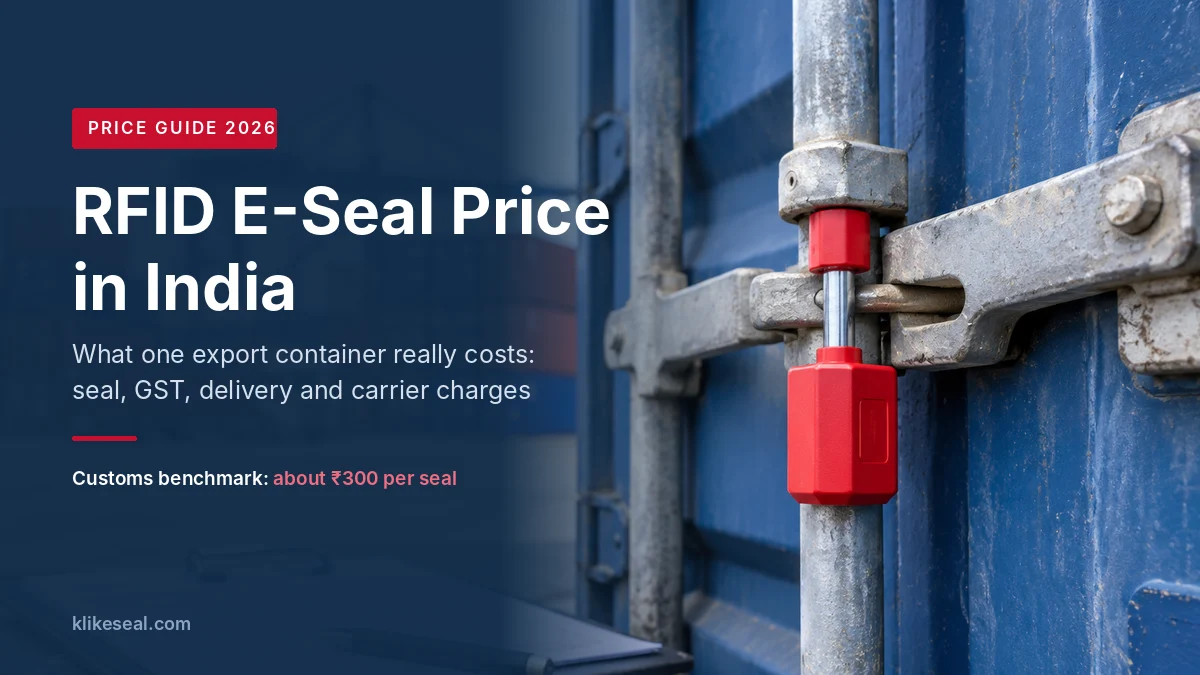

An RFID e-seal in India costs about ₹300 per seal before GST and delivery. That is the figure Jawaharlal Nehru Custom House (JNCH) gives in its e-sealing FAQ. One seal locks one export container, so the seal price is most of your sealing cost per container. GST, delivery and your shipping line’s own seal charge are added on top.
The RFID e-seal price in India is what an exporter pays a CBIC-empanelled vendor for one RFID one-time bolt seal used to self-seal an export container. Below we break that number down, show what it includes, and explain why some seals on marketplaces look far cheaper than they should.
Price checked: November 2026.
Key Takeaways
- JNCH’s e-sealing FAQ puts an RFID e-seal at about ₹300 per seal, excluding transport, GST and local charges.
- One e-seal locks one container, so the seal price is most of your sealing cost per container.
- E-seals are sold by the box, not loose. Klik e-Seal packs 10 seals per box.
- The shipping line’s seal charge is a separate carrier fee that the e-seal price doesn’t cover.
- Only seals from CBIC-empanelled vendors work for self-sealing. JNCH Public Notice 65/2025 counted 16 approved vendors.
RFID E-Seal Price in India (2026)
The JNCH FAQ on e-sealing puts the cost at about ₹300 per seal, excluding transport, GST and other local charges. That figure dates from the 2017 rollout of self-sealing, so treat it as a benchmark. Vendors set their own prices today.
| Item | Customs benchmark (JNCH FAQ) | Klik e-Seal |
|---|---|---|
| Price per seal, before GST | About ₹300 | Quoted on request |
| GST | Extra, not included | Extra, shown on invoice |
| Seals per box | Usually 20 or 30 | 10 per box |
| Sold loose? | No | No, sold by the box |
| Delivery | Extra | Included in your quote |
For a current Klik e-Seal quote with GST and delivery to your factory, ask our sales team.
What the Price Includes, and What It Doesn’t
When you buy a Klik e-Seal, the price covers:
- The RFID one-time bolt seal, made to ISO 17712:2013 (H) and ISO/IEC 18000-6 Class 1 Gen 2, as Circular 36/2017-Customs requires
- A laser-engraved serial number in the format KLIK12345678, which you enter in the shipping bill
- Access to the Klik e-Seal App, where you upload sealing data such as IEC, shipping bill number, container number and truck number
It does not cover:
- GST
- Courier or transport to your factory
- Your shipping line’s seal charge
- Customs broker fees, CFS charges or port charges
Specs for the seal itself are on our RFID bolt seal product page.
Cost per Container: The Full Breakdown
Exporters usually ask about the price of one seal. The number that hits your margins is the cost of sealing one container.
| Cost item | Who charges it | Amount | Source |
|---|---|---|---|
| RFID e-seal | E-seal vendor | About ₹300 benchmark | JNCH FAQ on e-sealing |
| GST on the e-seal | E-seal vendor, paid to government | Rate on vendor invoice | Vendor invoice |
| Delivery | E-seal vendor or courier | Spread across seals in the box | Vendor quote |
| Carrier seal charge | Shipping line | Example: USD 10 per container (MSC, from 1 June 2026) | Carrier’s India export local charges |
The E-Seal Itself
You use one e-seal per container. It is a one-time bolt seal. Customs reads it at the port, and the consignee cuts it at destination, so it can’t be used twice.
Here is a worked example using the customs benchmark. A box of 10 seals at ₹300 each costs ₹3,000 before GST. Each container you seal from that box carries ₹300 of seal cost, plus its share of GST and delivery. Swap in your vendor’s real price to get your own number.
GST on E-Seals
GST is charged on top of the seal price. The rate depends on how the vendor classifies the seal, so check the HSN code and rate printed on your invoice. Registered exporters can usually claim input tax credit on it. Confirm the treatment with your CA.
Delivery to Your Factory
Delivery cost depends on where your factory is and how many boxes you order. On a single box it can add noticeably to each seal. On larger orders it spreads thin. Ask your vendor for a delivered price, not just the seal price.
The Shipping Line’s Seal Charge
Shipping lines publish their own seal charge per container in their India export local charges. MSC, for example, lists a seal charge of USD 10 per container across India from 1 June 2026. Hapag-Lloyd rolls its seal fee into an Export Service Fee at Nhava Sheva.
This is a carrier charge, separate from the customs e-seal. The e-seal price doesn’t cover it. Whether your line still bills it on a factory-stuffed, e-sealed container depends on the line and your contract. Check your carrier’s local charges sheet or ask your customs broker before you budget.
Why Some E-Seal Listings Look Much Cheaper
Search for RFID e-seals on a B2B marketplace and you’ll find “RFID e-seal tags” listed at under ₹20. Most of these are plain UHF tags or labels. They are not ISO 17712 bolt seals, and they aren’t registered with Customs.
Only seals from vendors on the CBIC empanelled list work for self-sealing. JNCH Public Notice 65/2025 counted 16 approved vendors. It also confirmed that the universal e-seal reader at the JNPA Centralised Parking Plaza verifies seal status through ICES and ICEGATE.
A seal that isn’t in that system won’t read as valid at the gate. Check that your vendor is on the CBIC empanelled list before you pay.
Mechanical bolt seals also sell for ₹10 to ₹30 on marketplaces. They are a different product with no RFID chip. Our post on bolt seal vs RFID bolt seal explains where each one fits.
Our guide to CBIC-approved RFID e-seal vendors explains how to check a vendor before you pay.
What Changes the Price You Pay
Order Quantity and Box Size
E-seals are sold by the box. The JNCH FAQ notes vendors don’t sell them loose, and Klik e-Seal packs 10 seals per box. For larger orders, we offer special pricing. Contact sales@klikeseal.com with your monthly container count.
Vendor Support and Portal Access
The cheapest seal is not much use if the vendor’s app is down on a sailing day, or if nobody answers when a seal won’t read. Ask how sealing data gets uploaded, how fast support responds, and what happens if a seal is lost before use.
Klik e-Seal’s tech team is available 24×7 for sealing and app issues.
Delivery Location and Lead Time
Factories far from major cities usually pay more for delivery and wait longer. Exporters running close to a vessel cutoff often pay for express courier. Keeping one box in stock ahead of your shipping schedule avoids both.
Is the Cost Worth It Compared to CFS Stuffing?
Without self-sealing permission, your cargo goes to a CFS or ICD to be stuffed and sealed. You pay handling and transport for that extra stop and lose time at the yard. With self-sealing, you stuff at your factory, fit the e-seal and send the container straight to the port.
- Factory stuffing→
- E-seal fitted→
- Data uploaded→
- Seal read at port
To compare for your own business, take a recent CFS invoice for one container and set it against the delivered cost of one e-seal. The answer depends on your lanes and volume, so use your own numbers.
Seal quality affects cost too. Under Circular 41/2017-Customs, a container whose seal reads as tampered goes for physical examination. That means delay and extra charges. Our post on what happens if an RFID e-seal fails verification at the port covers the common causes.
If you don’t have permission yet, start with our step-by-step guide to RFID e-seal self-sealing permission.
Need a delivered price for your next box of e-seals?
Klik e-Seal supplies CBIC-approved RFID e-seals made to ISO 17712:2013 (H), with app access and 24×7 support.
Request a QuoteHow to Order E-Seals from Klik e-Seal
1. Register with your IEC
Register on the Klik e-Seal website with your IEC and company details. Under Circular 36/2017, vendors must link seals to the buying exporter.
2. Share your self-sealing permission
The JNCH FAQ lists IEC and self-sealing permission as required to buy e-seals.
3. Choose your quantity
Choose your quantity in boxes of 10.
4. Pay and receive your seals
Pay and receive your seals with Klik e-Seal App login details.
5. Seal and upload the data
After stuffing, fit the seal, upload the sealing data in the app and enter the seal number in your shipping bill.
Klik e-Seal is a CBIC-approved RFID e-seal vendor. Our seals are made to ISO 17712:2013 (H) and ISO/IEC 18000-6 Class 1 Gen 2. For a delivered price on your next order, contact our team or browse our full product range.
Need live location during transit? A passive RFID e-seal is read at checkpoints such as the port gate. It doesn’t send its location along the way. For real-time tracking, look at our GPS smart electronic lock.
Frequently Asked Questions
How much does an RFID e-seal cost in India?
JNCH’s e-sealing FAQ puts an RFID e-seal at about ₹300 per seal, before GST, transport and local charges. Current vendor prices vary, so ask for a delivered quote that includes GST.
Is GST charged on RFID e-seals?
Yes. GST is charged on top of the seal price. Check the HSN code and rate on your vendor’s invoice, and ask your CA about claiming input tax credit.
Can I buy a single RFID e-seal?
No. Vendors sell e-seals by the box, not loose. The JNCH FAQ mentions boxes of 20 or 30, and Klik e-Seal packs 10 seals per box.
Do I need self-sealing permission to buy e-seals?
Yes. The JNCH FAQ says an IEC and self-sealing or factory stuffing permission are required to buy e-seals from CBIC-approved vendors.
Does the e-seal price include the shipping line’s seal charge?
No. The shipping line’s seal charge is a separate carrier fee listed in its India export local charges. Check with your carrier or customs broker whether it applies to your factory-stuffed containers.
Why are some RFID seals on marketplaces so cheap?
Most low-priced “RFID e-seal tags” are plain UHF tags, not ISO 17712 bolt seals. Only seals from CBIC-empanelled vendors are accepted for self-sealing export containers in India.
Can an RFID e-seal be reused?
No. An RFID e-seal is a one-time bolt seal. It is cut open at destination and must be replaced with a new seal for every container.
Final Thoughts
The seal price is the easy part of the cost. The bigger numbers are a container held for examination because a seal didn’t read, or a sailing missed because seals arrived late. Look at the delivered cost and the vendor’s support along with the seal price.
If your volume is steady, plan seal orders around your shipping calendar and keep a box in reserve. Ask Klik e-Seal for a quote with your monthly container count, and we’ll give you a delivered price with GST.
Sources: JNCH FAQ on e-sealing; JNCH Public Notice 65/2025; CBIC Circulars 36/2017-Customs and 41/2017-Customs