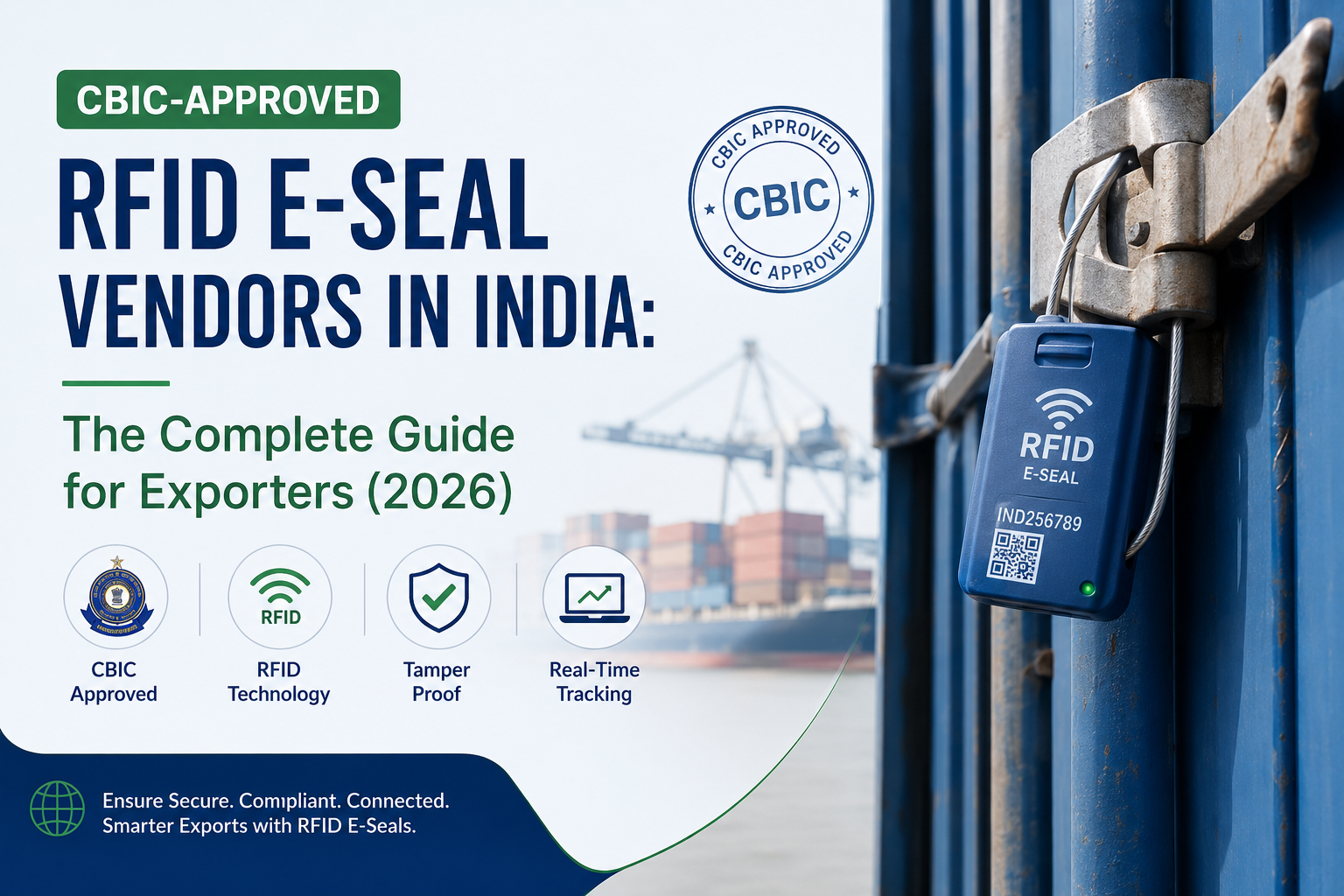

CBIC-approved RFID e-seal vendors are companies authorized by India’s Central Board of Indirect Taxes and Customs to supply electronic container seals for export self-sealing. Approved vendors must meet ISO 17712:2013(H) and ISO/IEC 18000-6 Class 1 Gen 2 standards, install RFID readers at ports and ICDs, and link every seal to the exporter’s IEC code.
We’ve seen exporters arrive at a CFS only to find their seal supplier was no longer on the approved vendor list. The shipment doesn’t move until that gets sorted out, and by then the transporter is billing demurrage.
This guide covers the current vendor list, the compliance framework behind it, and how to pick a supplier without learning the hard way what a bad one costs you.
In this guide
What Is a CBIC-Approved RFID E-Seal?
Picture a container being loaded at a factory in Vapi, Ludhiana, or Chennai. Once the doors close, an RFID e-seal goes on the locking bars. The seal carries a unique RFID chip and ID number, tied to the exporter’s IEC code in the vendor’s database, readable electronically at the port.
Tamper with it, and the evidence is visible, either physical damage to the seal body or a chip that stops responding. That’s the entire point: Customs needs confidence that the container arriving at the port is the one that left the factory.
CBIC Circulars 26/2017, 36/2017, 37/2017, and 41/2017 set the framework. Approved vendors must meet two standards: ISO 17712:2013(H) for mechanical seal security, and ISO/IEC 18000-6 Class 1 Gen 2 for RFID readability at Indian ports running UHF scanners in the 860 to 960 MHz range.
This is the backbone of India’s self-sealing export scheme. Exporters already approved for self-sealing, and Authorised Economic Operators, can stuff and seal containers at their own premises without a Customs officer present, provided the seal comes from an approved vendor.
Complete List of CBIC-Approved RFID E-Seal Vendors
CBIC’s original approved-vendor list runs to twelve names, published under Circular 37/2017-Customs (F.No. 450/188/2017-Cus IV). Several have since become the recognizable market brands; a few names haven’t updated public visibility since. One vendor on that original list, Thar Shipping Lines LLP, was suspended for six months for non-compliance, which is a useful reminder that “approved” isn’t permanent status.
Klik eSeal (Jainam Multi-Product India Pvt. Ltd.)
Headquartered in Vapi, Gujarat, Klik eSeal is the entry that’s been operating longest among the active brand names on this list. Over 5,000 exporters have used their seals, including ITC, Panasonic, Nestlé, Bharat Forge, and Haldiram. Their range covers RFID bolt seals, 3-state and active RFID cable seals, RFID plastic seals, and GPS e-seal trackers, all meeting ISO 17712:2013(H) and ISO 18000-6C.
Other vendors on the CBIC-approved list
| Vendor | Headquarters | Notes |
|---|---|---|
| ID Tech Solutions Pvt. Ltd. | Gurgaon, Haryana | ISO 9001 certified, tamper-proof bolt seals |
| Sepio Products Pvt. Ltd. | Vasai (E), Palghar, Maharashtra | Also operates via The PDP Group partnership |
| Warner Industries | Mumbai | Bolt seals for container export |
| AAA Products Pvt. Ltd. | Gurugram, Haryana | Trades as Boltseal |
| Perfect RFID Technologies Ltd | New Delhi | Original 2017 circular listing |
| ibTrack Solutions Pvt. Ltd. | Bengaluru | Original 2017 circular listing |
| Optiemus Telematics Pvt. Ltd. | Noida | Trades as Lynkseals |
| Infotek Software & Systems (P) Ltd. | Pune | Original 2017 circular listing |
| Pack Seals Industries | Mumbai | Original 2017 circular listing |
| Great Eastern IDTech Pvt. Ltd. | Gurgaon, Haryana | Original 2017 circular listing |
| Enopeck Seals Industries | Mumbai | Original 2017 circular listing |
What Approved Vendors Are Required to Do
Approval comes with obligations, and knowing them helps you spot a vendor cutting corners before it becomes your problem.
- Install RFID readers at ports and ICDs, and report that list to CBIC. If your vendor hasn’t installed a reader where you actually ship from, your seal won’t scan there.
- Give exporters visibility into transaction history. You’ll need this during audits.
- Link each seal’s TID number to your IEC code at time of sale. No linkage, no recognition at the port.
- Maintain compliance documentation under Circular 36/2017 and the circulars that followed. Buy from a vendor who’s let this lapse, and your self-sealing permission is worth nothing on that shipment.
How to Choose the Right Vendor
Being on the approved list is the minimum bar, not the differentiator. Before you commit:
- Port coverage. Ask for their actual reader list, not a verbal assurance. If you ship through JNPT, Mundra, or Chennai and they have no readers there, move on.
- The right seal type. Bolt seals for standard ISO dry containers, cable seals for non-standard closures, active or 3-state RFID if you want real-time tamper alerts instead of passive scans.
- Supply reliability. Ask about lead times, minimum order quantities, and whether they hold stock through peak season. A vendor who runs dry in October isn’t much use in October.
- Support hours. Customs problems don’t wait for business hours. Confirm round-the-clock support actually exists, not just in the sales pitch.
- Price, last. A cheap seal from an unapproved or lapsed vendor isn’t a saving, it’s a compliance failure paid for in advance.
Common Mistakes Exporters Make
- Buying from a vendor no longer on the current list. Approvals lapse and get suspended; a vendor that was fine two years ago may not be today.
- Assuming self-sealing permission covers vendor choice. It doesn’t. Permission and vendor approval are separate checks.
- Not confirming reader coverage at your actual port of export, rather than wherever the vendor happens to have installed readers.
- Treating price as the deciding factor over port coverage and documentation.
- Not verifying TID-IEC linkage before the first shipment, which is the single most common cause of a seal failing to read at the gate.
The CBIC Circulars That Govern E-Sealing
| Circular | What it covers |
|---|---|
| 26/2017-Customs | Introduced self-sealing for containerized exports |
| 36/2017-Customs | Set the RFID e-seal standards and vendor documentation requirements |
| 37/2017-Customs | Published the verified vendor list and vendor obligations |
| 41/2017-Customs | Clarified self-sealing procedure for specific exporter categories |
| 44/2017-Customs | Extended and refined self-sealing eligibility |
Verify current text and any amendments on cbic.gov.in before relying on circular numbers for compliance filings; this table summarizes scope, not the full legal text.
How to Buy RFID E-Seals: Step-by-Step
- Get self-sealing permission from your jurisdictional Customs Commissioner, if you don’t already have it.
- Verify your chosen vendor against the current CBIC-approved list, not last year’s screenshot.
- Confirm reader coverage at the port or ICD you actually export from.
- Place your order with your IEC code so seals get linked correctly.
- Affix the seal during container stuffing at your factory.
- Record the seal number on your shipping bill and export documentation.
- At the port, Customs scans the seal via the vendor’s installed readers, confirming tamper-free delivery.
Ready to get CBIC-compliant?
Contact Klik eSeal for a QuoteFrequently Asked Questions
Can I use any RFID seal for customs compliance in India?
No. Only seals from CBIC-approved vendors qualify under the self-sealing scheme. An unapproved seal won’t be accepted at the port, regardless of build quality.
How many CBIC-approved RFID e-seal vendors are there in India?
CBIC’s original published list under Circular 37/2017-Customs named twelve vendors. The active count changes as approvals lapse or new vendors complete documentation, so treat any fixed number as a snapshot, not a permanent figure.
Has the CBIC-approved vendor list changed since it was first published?
Yes. At least one original vendor, Thar Shipping Lines LLP, was suspended for non-compliance. CBIC has stated that verification of new vendor applications is ongoing, meaning the list can add or drop names over time.
What happens if a seal is tampered with during transit?
The seal shows it, either visible physical damage or an RFID chip that stops responding. Either signals the container for inspection at the port.
Does self-sealing permission expire?
No. Once granted, it remains valid unless withdrawn by Customs, with no periodic renewal required.
Can I use RFID e-seals on reefer containers?
Yes, under separate CBIC instructions for refrigerated container stuffing and sealing. Confirm with your vendor directly that their seals are rated for sustained low temperatures, since not all are.
Final Word
The self-sealing framework has cut real time out of the export process, fewer factory inspections, faster port clearance, less paperwork chasing. It only works, though, if the vendor is genuinely on the current approved list, the seal type matches your container, and readers exist at the ports you actually use. Check those three before price.