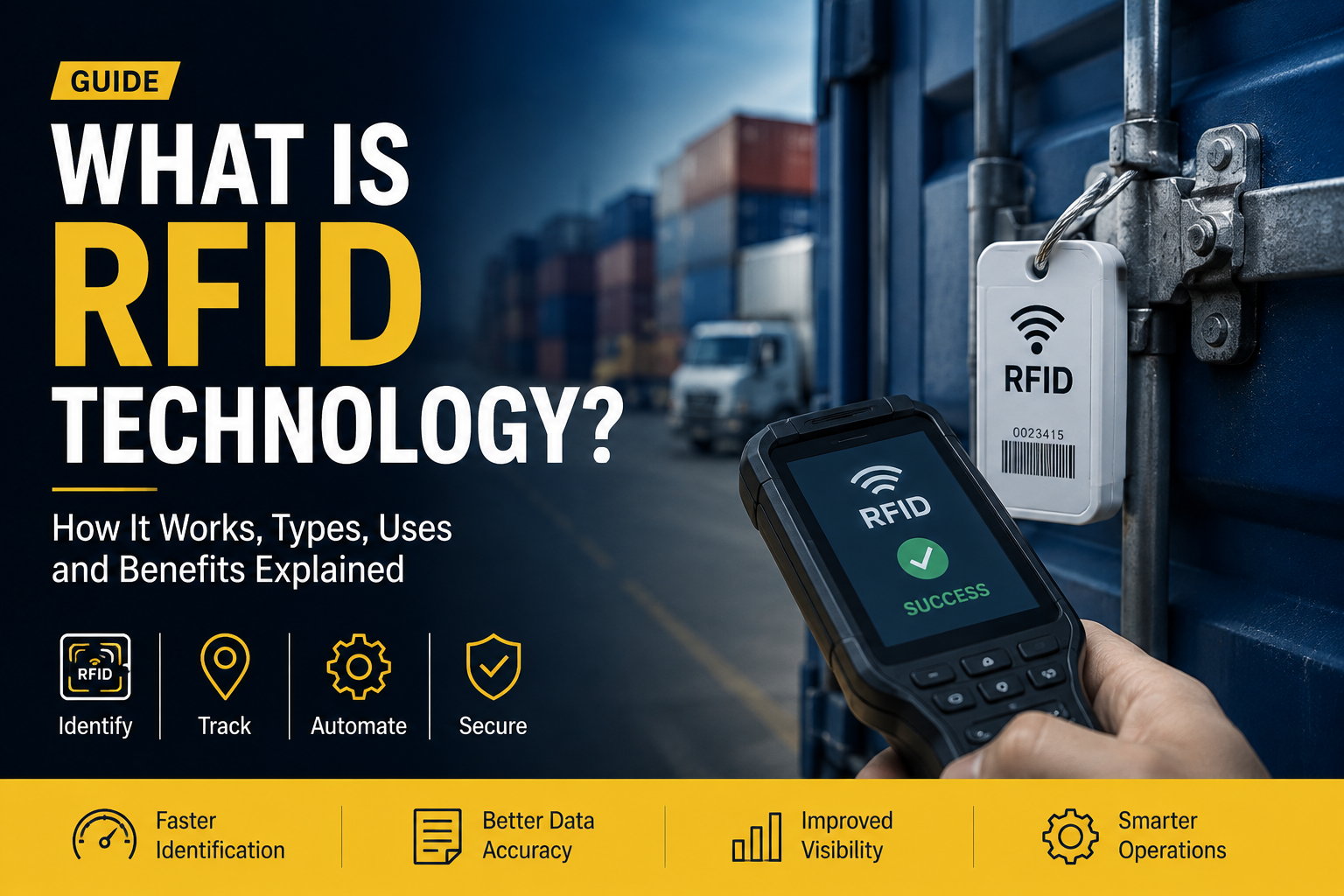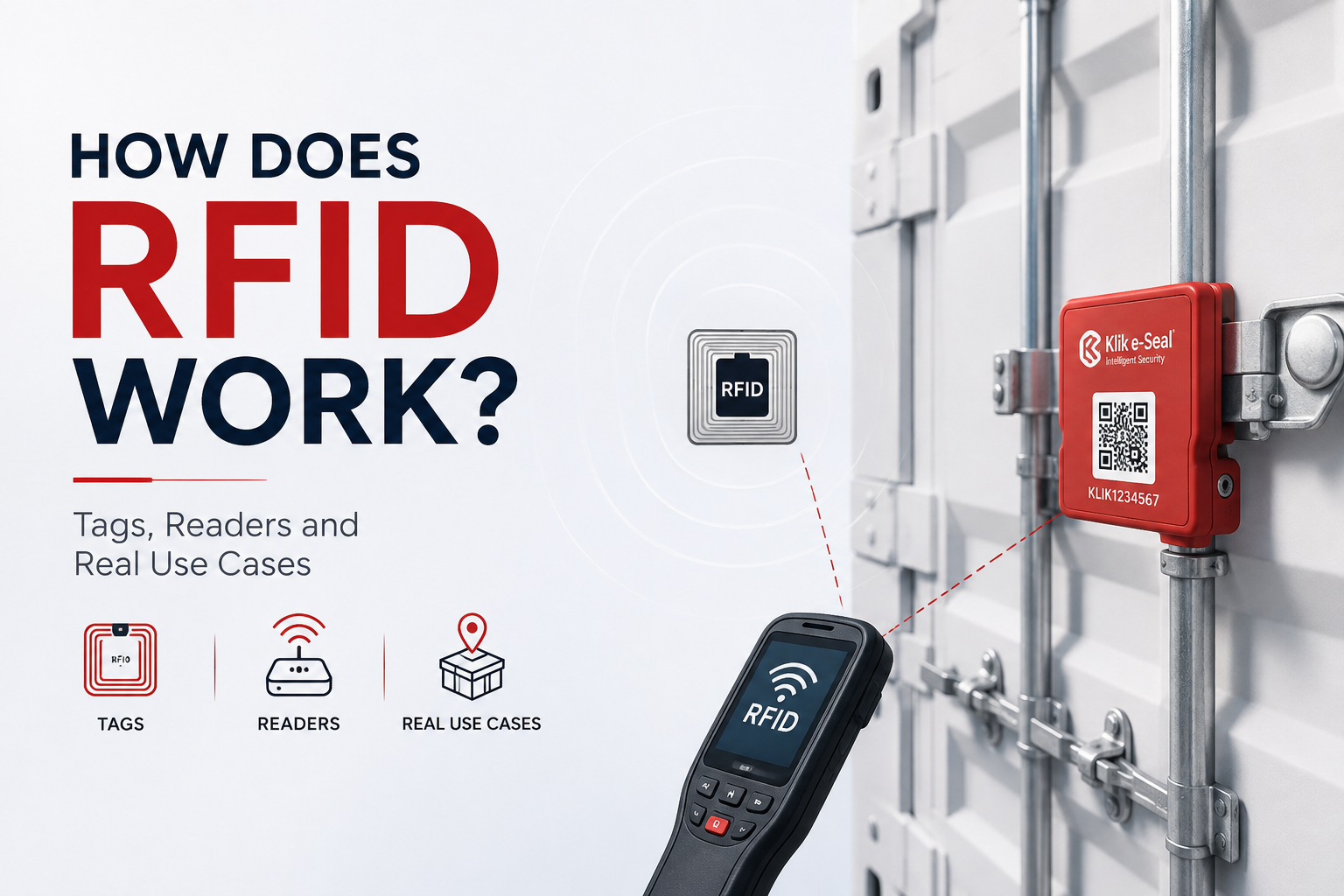

RFID (radio frequency identification) works by using radio waves to transfer data between a tag and a reader without contact or line of sight. The reader’s antenna emits a radio signal, the tag’s antenna picks it up and powers or activates its microchip, and the chip transmits back a stored unique identifier the reader decodes.
Most people meet RFID without noticing it, at a toll plaza or an office door. The same technology, at a different frequency and inside a hardened housing, is what Customs relies on to confirm that a container reaching the port still has the doors it left the factory with.
This guide covers the read cycle itself, the differences between tag types and frequency bands, and how the same physics gets applied inside a CBIC-compliant container e-seal.
The Four Steps of an RFID Read
Everything RFID does, from a library book label to a customs-approved bolt seal, is a variation on the same four-step exchange.
1. The reader emits a radio signal
The RFID reader antenna broadcasts an interrogating signal in its assigned frequency band, either continuously or when triggered. What it creates is a field, not a beam, which is why tag orientation matters far less here than alignment does with a barcode scanner.
2. The tag antenna captures the signal
This is the step most explanations skip past. A passive RFID tag has no battery at all. Its antenna harvests energy directly from the reader’s field, through inductive coupling on low and high frequency, or through backscatter coupling on UHF, and uses that harvested energy to power its own chip. An active tag treats the same signal as a wake-up trigger, because its onboard battery does the powering.
3. The chip returns its data
The microchip reads its stored memory, typically a unique identifier such as an EPC, plus any user-writable fields, and modulates that data onto a return signal.
4. The reader decodes and hands off
The transceiver demodulates the response and applies an anti-collision protocol, so hundreds of tags sitting in the same field are read without interfering with each other. The data then passes to middleware and on to a WMS, an ERP, or a customs portal.
Where deployments actually fail: that final handoff. A read is only worth something if a backend system maps the identifier to a real record. Good tags paired with no data model produce a very expensive way to generate meaningless numbers.
Passive vs Active RFID Tags
| Attribute | Passive | Active |
|---|---|---|
| Power source | Harvested from reader field | Onboard battery |
| Read range | A few cm to 30+ m (UHF) | Roughly 100 to 300 m |
| Cost per tag | Low, cents to a few dollars | High, tens of dollars upward |
| Lifespan | Effectively unlimited | Limited by battery, typically 3 to 5 years |
| Size and weight | Thin, light, can be a paper label | Bulkier, housing required |
| Typical use | Retail items, pallets, container seals | Vehicle fleets, high-value asset tracking |
A third category, battery-assisted passive, sits between the two. It carries a small battery to power the chip but still relies on backscatter to communicate, buying extra range without full active-tag cost.
An RFID bolt seal is a passive UHF tag placed inside a hardened housing, where the tag itself is cheap but the mechanical body around it does the heavy work. An active RFID cable seal suits applications that need long-range visibility rather than verification at a fixed gate.
RFID Frequency Bands
Band choice determines range, cost, and how a tag behaves near metal and water. It is the decision that constrains everything downstream.
| Band | Frequency | Typical range | Metal and liquid | Common use |
|---|---|---|---|---|
| Low frequency (LF) | 125 to 134 kHz | 1 to 10 cm | Largely unaffected | Animal tagging, access control |
| High frequency (HF) | 13.56 MHz | Up to about 1 m | Moderately affected | NFC, contactless payment, library systems |
| Ultra high frequency (UHF) | 865 to 960 MHz | 5 to 6 m typical, 30+ m with large tags | Significantly affected unless on-metal designed | Supply chain, logistics, container seals |
| Active | 433 MHz and 2.45 GHz | 100 to 300 m | Less sensitive, battery compensates | Fleet and real-time location tracking |
The India-specific detail most guides miss. UHF is split by region. India operates on a de-licensed band of 865 to 867 MHz allocated by the Wireless Planning and Coordination Wing, Europe uses 865 to 868 MHz, and North America uses 902 to 928 MHz. A reader or tag specified for the American band will underperform or fail compliance in India. Most explainers written for a US audience quote 902 to 928 MHz without noting the distinction, which is worth remembering when you are reading imported spec sheets.
RFID vs Barcode
| Factor | RFID | Barcode |
|---|---|---|
| Line of sight | Not required | Required |
| Read rate | Hundreds simultaneously | One at a time |
| Range | Centimetres to metres | Centimetres |
| Cost per unit | Higher | Very low |
| Durability | High, can be sealed or embedded | Low, damaged by dirt and abrasion |
| Rewritable | Yes on many tags | No |
Barcodes are not obsolete. For low-value, low-volume items where an operator is already handling each unit, a printed label costs a fraction of a penny and RFID cannot justify itself. RFID wins where volume, speed, or hostile physical conditions make individual scanning impractical. For the hardware side of this comparison, see RFID readers vs barcode scanners.
Where RFID Gets Used
- Retail inventory counting and loss prevention
- Warehouse pallet and carton tracking
- Building access cards and keyless entry
- Highway toll collection, which in India means FASTag
- Fixed asset and tool tracking
- Livestock identification
- Library circulation
- Export container security
FASTag is the useful reference point for most Indian readers. If you have driven through a toll plaza without stopping, you have already used a passive UHF RFID system at national scale. Container e-sealing applies the same physics to a different problem, and reads it with the same class of UHF reader hardware.
How RFID Works Inside a Container E-Seal
An RFID e-seal is a mechanical bolt seal with a UHF RFID tag embedded in its body. The bolt gives physical tamper evidence, because breaking it is visible and it cannot be reclosed. The tag gives electronic tamper evidence, because its unique serial is registered against a specific consignment and cannot be silently swapped.
The read cycle at a port gate
At the point of stuffing, the seal is applied and its serial number is registered against the container number, shipping bill, date and time of sealing, destination, and truck number. The consignment then moves. At the port gate, a fixed UHF gateway reader or a handheld device reads the seal without the container being opened and without the truck stopping for manual inspection. The system compares what it reads against what was registered.
What happens when the seal is tampered with
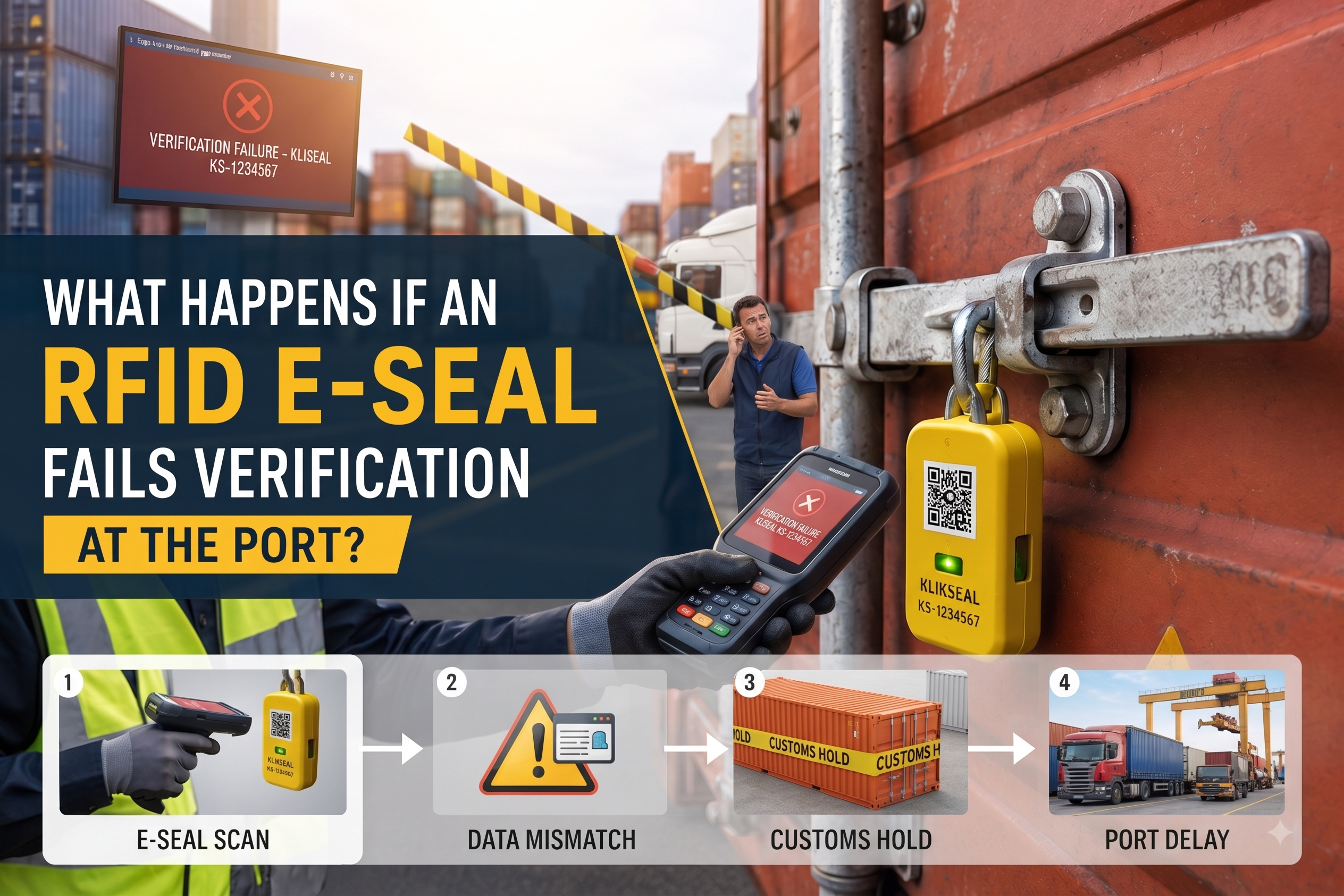
If the seal has been cut, the RFID tag is physically separated from the bolt and the read either fails or returns a mismatch. There is no way to break a container open and then present a valid electronic identity afterward. That combination, mechanical and electronic evidence in a single unit, is what Customs is actually relying on.
The principle scales up. A GNSS bolt seal or a GPS e-seal tracker adds continuous position reporting on top of the gate-point RFID read, which matters on long-haul and cross-border movements where the gap between two read points is measured in days rather than metres.
E-Seal Rules for Indian Export Containers
The Central Board of Indirect Taxes and Customs permits eligible exporters to self-seal export containers electronically, removing the requirement for factory stuffing under the physical supervision of a Customs officer.
The requirements are specific. The seal must be a one-time-use RFID tamper-proof bolt seal bearing a unique serial number, conforming to ISO 17712:2013(H) for mechanical strength and tamper evidence, and to ISO/IEC 18000-6 Class 1 Gen 2 for the RFID air interface. Exporters must hold GST registration and be filing GST returns to qualify for self-sealing.
The operational benefit is direct. Exporters no longer incur Merchant Overtime charges for officer supervision, and containers move faster because gate clearance does not depend on a manual inspection queue.
Verify before you rely on it. The self-sealing procedure has been revised more than once since introduction, so check the current text on cbic.gov.in before acting on any specific procedural detail. Our guide to CBIC-approved RFID e-seal vendors in India covers the vendor approval side in full.
What RFID Does Not Do Well
Vendors rarely publish this list, so it is worth stating plainly.
- Metal and liquid detune passive tags. A UHF tag that reads at six metres in open air may read at centimetres when mounted flat on steel, unless it is specifically built as an on-metal tag.
- Published read ranges are lab figures. Real warehouses have racking, forklifts, and reflective surfaces. Expect meaningful degradation.
- Tag cost still rules RFID out for cheap items. At low unit value, the tag can cost more than the margin on the product.
- Reading everything in a zone cuts both ways. Stray reads from an adjacent dock door are a real and common problem, and fixing them takes antenna tuning and power management, not just better tags.
Specifying RFID for cargo security?
Klik eSeal is a CBIC-approved RFID e-seal manufacturer supplying seals compliant with ISO 17712:2013 Clauses 4, 5 and 6 and ISO 18000-6 Class 1 Gen 2, across 10+ Indian ports and ICDs.
Contact Klik eSeal for a QuoteFrequently Asked Questions
How does an RFID tag get power if it has no battery?
A passive RFID tag harvests energy from the radio field the reader emits. The tag’s antenna converts that incoming electromagnetic energy into enough current to power the microchip for the fraction of a second it needs to transmit its stored data back.
What is the maximum read range of RFID?
Passive low frequency tags read at 1 to 10 centimetres. Passive UHF tags typically read at 5 to 6 metres, and large UHF tags can reach 30 metres or more in ideal conditions. Active tags with onboard batteries reach roughly 100 to 300 metres.
Can RFID work through metal or liquid?
Not reliably with standard passive UHF tags, because metal reflects radio waves and water absorbs them. On-metal tags use a spacer or ground plane to work on metallic surfaces. Low frequency RFID is far less affected by both, which is why it is used for livestock and access control.
What is the difference between RFID and NFC?
NFC is a subset of high frequency RFID operating at 13.56 MHz, limited to a few centimetres and designed for two-way communication between devices. General RFID covers a much wider set of frequencies and ranges, and is usually one-way from tag to reader.
Which RFID frequency is used in India?
India’s de-licensed UHF RFID band is 865 to 867 MHz, allocated by the Wireless Planning and Coordination Wing of the Department of Telecommunications. Equipment specified for the North American 902 to 928 MHz band is not compliant for use in India.
Can an RFID tag be cloned or hacked?
Basic tags that transmit an unencrypted identifier can be read and replicated with the right equipment. Tags used in security applications support password protection, encrypted memory banks, and permanent locking of the identifier, which is why the standard a seal conforms to matters more than the fact that it uses RFID.
How does an RFID e-seal detect tampering?
The RFID tag is integrated into the bolt itself. Cutting the bolt to open the container physically separates or destroys the tag, so a subsequent read either fails or returns a serial that does not match the one registered against that container and shipping bill.
Is an RFID e-seal mandatory for export containers in India?
It is required for exporters choosing to self-seal containers without Customs officer supervision under the CBIC procedure. Exporters who opt for supervised stuffing follow a different route. Confirm current requirements against the applicable CBIC circular.
Final Word
RFID is not complicated at the level that matters for a buying decision. A reader makes a field, a tag answers, a backend turns that answer into a record. What changes between a retail label and a container seal is the frequency band, the housing, and the standard it has to conform to. Get the band right for India, get the housing right for the container type, and confirm the standard before the seal leaves the supplier.
Sources: ISO 17712:2013; ISO/IEC 18000-6 Class 1 Gen 2; GS1 EPC UHF Gen2 air interface protocol specification; Wireless Planning and Coordination Wing, Department of Telecommunications, India, de-licensed band notification for 865 to 867 MHz; CBIC circulars on self-sealing of export containers, cbic.gov.in.