
Before you order from an RFID seal supplier, get four answers in writing: the minimum order, the real lead time, proof that the seal meets ISO 17712, and, if you export from India, proof that the vendor is on the current CBIC approved list.
A bad answer usually shows up at the worst moment. The seal doesn’t read at the port gate, the stock runs out in peak season, or the “certificate” turns out to cover a different model. This guide lists the questions to ask, what a good answer looks like, and the answers that should make you look elsewhere.
First, know which rules apply to you
The right questions depend on why you’re buying RFID seals. Most buyers fall into one of three groups.
| Your use case | What the seal must meet | Who checks it |
|---|---|---|
| Indian exporter self-sealing FCL containers | ISO 17712:2013 and ISO/IEC 18000-6 Class 1 Gen 2, bought from a CBIC approved vendor (Circular 36/2017-Customs) | Customs at the port or ICD, through the vendor’s system |
| Shipper sending containers to the US under CTPAT | ISO 17712 high security (“H” class) seal | US CBP and your CTPAT validation |
| Private fleet, warehouse or in-plant use | Your own spec, often ISO 17712 by choice | Your security or audit team |
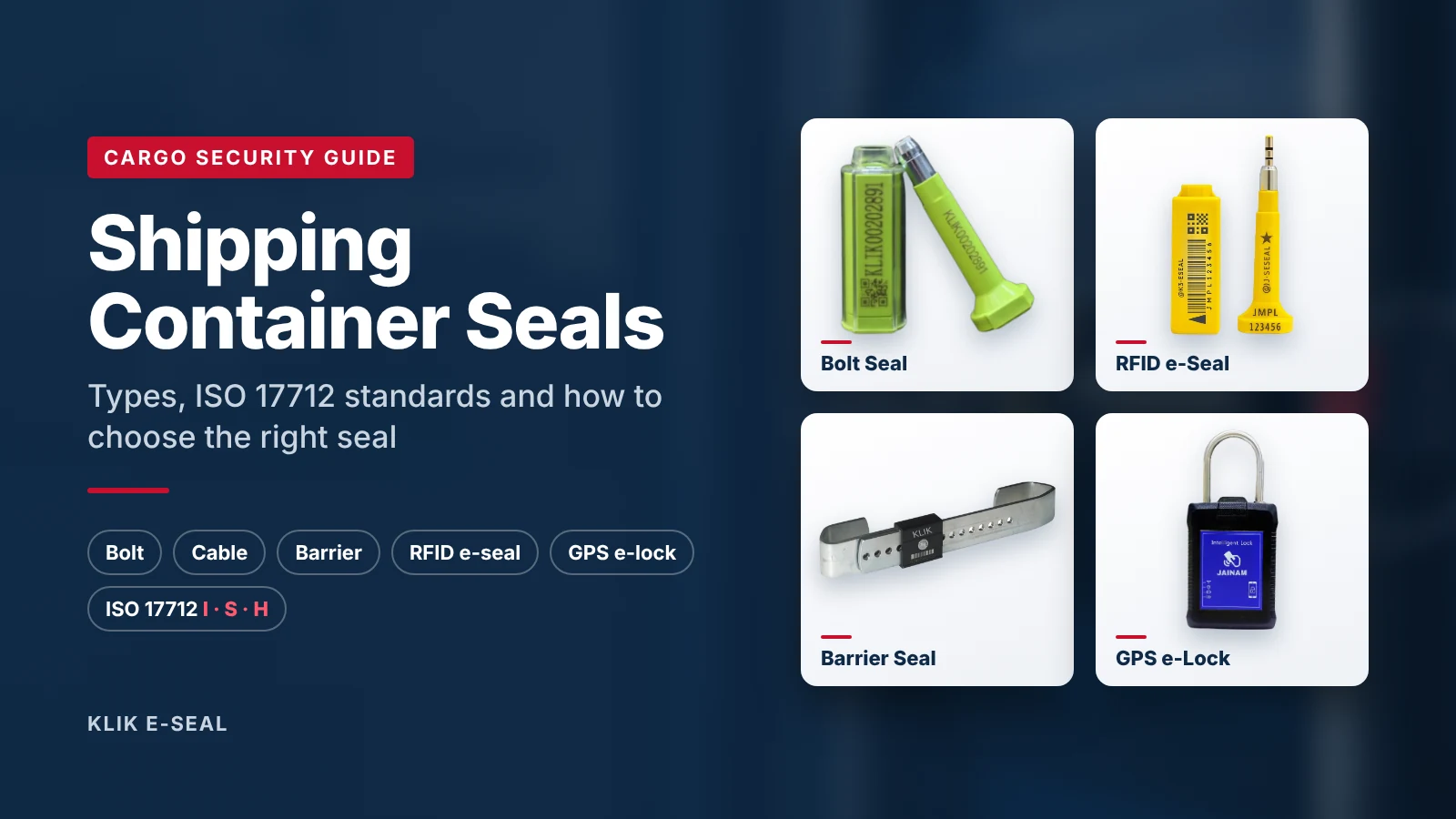
If you haven’t picked the seal type yet (bolt, cable or barrier), start with our bolt seal buying guide. This post is about checking the supplier, not choosing the seal.
Questions about MOQ and ordering
Ask for the minimum order, whether it is counted per box or per production run, and whether custom printing changes it.
| Question | Why it matters | Good answer | Red flag |
|---|---|---|---|
| What is your minimum order for this model? | Sets your first-order cost | A clear number, tied to a box or carton size | “Depends”, with no number even after you give your volume |
| Does the MOQ change for my logo, barcode or number series? | Custom work often needs a separate run | A separate MOQ and lead time for custom orders | Same MOQ quoted for stock and custom seals |
| Can I get samples of the exact model? | Lets you test fit on your doors and read on your reader | Yes, same model and same chip as the bulk order | Samples of a “similar” seal |
| What documents do you need from me? | Some seals can’t be sold to just anyone | For Indian e-seals: your IEC and self-sealing permission | No questions asked about your permission |
For CBIC e-seals in India, the minimum order is usually a box. The Jawaharlal Nehru Custom House FAQ on e-sealing says no minimum or maximum quantity is prescribed, but e-seals are generally sold in boxes of 20 or 30 and not loose. The same FAQ says an IEC and self-sealing or factory stuffing permission are compulsory to buy them.
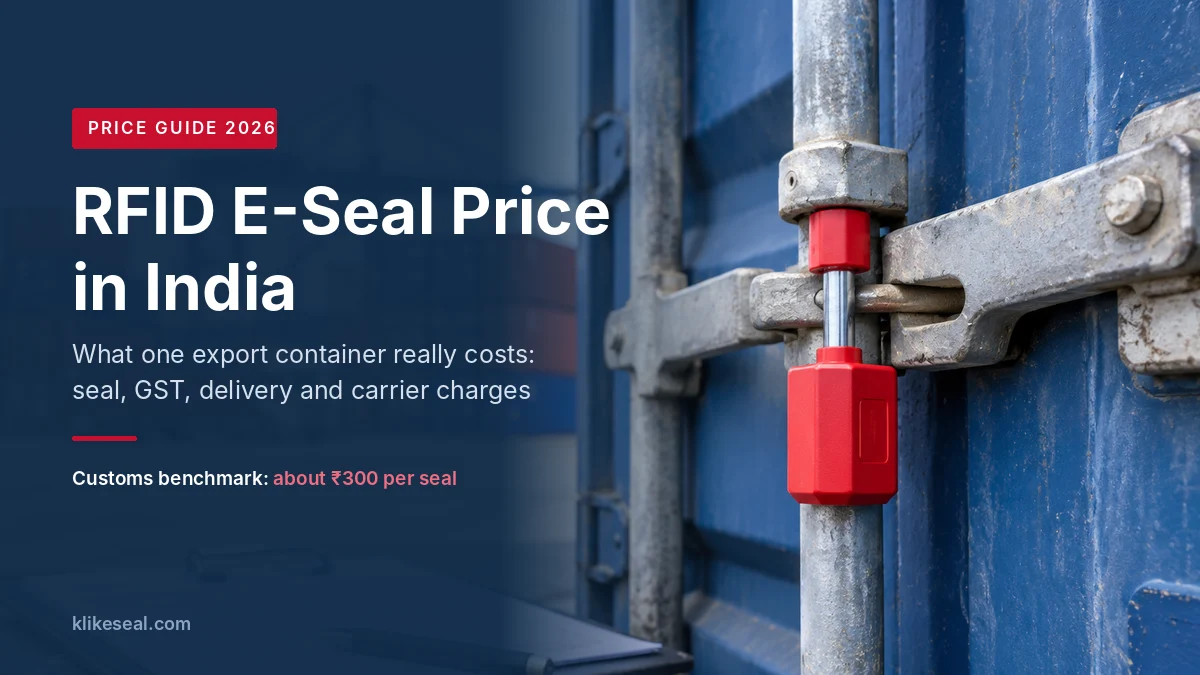
Custom RFID seals for private use work differently. Each maker sets its own minimum, so ask rather than assume. If cost is your main question, our breakdown of the RFID e-seal price in India covers what one container really costs.
Questions about lead time and stock
Lead time has three parts: stock on hand, production time for custom orders, and transit to your site. Ask for each one separately.
| Question | Why it matters | Good answer | Red flag |
|---|---|---|---|
| How many units of this model are in stock today? | Stock orders ship fastest | A number, or a dispatch date for your quantity | “Plenty”, with no figure |
| What is the lead time for custom printed seals? | Custom runs take longer than stock | A time in days or weeks, in writing | No written date |
| Does lead time start from order, payment or artwork approval? | Changes your real delivery date by days | One clear start point | Lead time that starts “after confirmation” |
| For e-seals, when is the seal number active in your system? | A seal that isn’t registered won’t help at the gate | Active and linked to your IEC before you use it | Unclear, or “it’s automatic” with no check |
If you ship to fixed sailing dates, ask the supplier to put the delivery date on the order confirmation. A verbal “next week” is hard to hold anyone to when a container misses its cut-off.
Questions about certification
A supplier can say “ISO certified” and mean very different things, so ask for documents, not claims.
ISO 17712: what to ask for and how to read it
ISO 17712:2013 is the current edition of the standard for freight container mechanical seals. It sorts seals into three classes: I (indicative), S (security) and H (high security). You can check the edition on the ISO page for ISO 17712:2013. There is no 2025 edition, so treat any “ISO 17712:2025” claim as a warning sign.
Ask for these documents for the exact model you’re buying:
- The lab test report or certificate of conformance for the mechanical tests (Clause 5).
- Evidence on tamper evidence (Clause 6).
- Evidence that the maker follows the standard’s security practices for manufacturers (Annex A).
When the report arrives, check five things:
- The lab is accredited to ISO/IEC 17025 for the ISO 17712 tests.
- Every mechanical test (tensile, shear, bending, and impact at room and low temperature) is rated “High Security”.
- The model number on the report matches the seal on your quote.
- The test date is recent. Lab certificates for these tests cite Clause 5.1.2, which says testing is repeated every two years.
- The seal itself carries an “H” mark and the maker’s name.
A Clause 5 report on its own does not make a seal “H” class. You need the tamper evidence side too.
Ask for the maker’s ISO 9001 certificate, with the certificate number and the body that issued it. It shows the factory runs a quality system. It does not prove a seal passed ISO 17712, so don’t accept it in place of the lab report.
For US-bound cargo, the CTPAT program asks members to keep proof that their seals meet the current ISO 17712 high security standard, and a copy of the lab test certificate is the usual evidence. See CBP’s CTPAT program pages for the current criteria.
CBIC vendor approval for Indian exports
If you self-seal export containers in India, ISO 17712 alone isn’t enough. The seal must come from a vendor on the CBIC approved list, and it must also meet ISO/IEC 18000-6 Class 1 Gen 2 for the RFID part.
Ask the supplier:
- Are you on the current approved vendor list, and under which company name?
- What is your declared seal number series?
- Are you the approved vendor, or are you selling for one?
The JNCH FAQ says approved vendors cannot appoint distributors and orders are placed directly with the vendor. Customs also says it is not responsible for a vendor’s conduct, so the risk of a bad vendor sits with you.
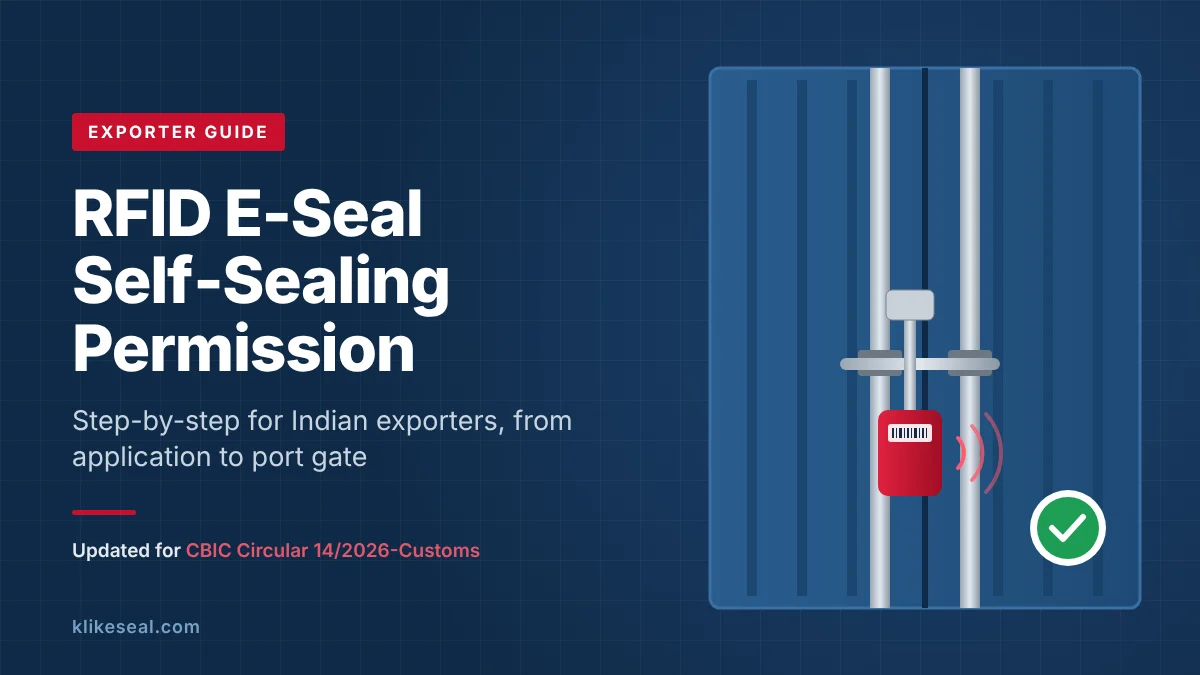
Check the current list yourself instead of trusting a screenshot. Vendors have been suspended from the list before. Our guide to CBIC approved RFID e-seal vendors explains how the list works, and if you don’t have permission yet, start with how to get self-sealing permission.
Questions about the RFID side
Whether the seal is read at the gate depends on the chip and the vendor’s system as much as on the steel.
| Question | Why it matters | Good answer | Red flag |
|---|---|---|---|
| Which RFID standard does the chip follow? | Must match port and customs readers | ISO/IEC 18000-6C (EPC Gen2), with the chip named | “Standard RFID” with no detail |
| Is the seal’s identity checked against its TID at the read? | Stops cloned seal numbers | Yes, and the vendor explains how | No idea what TID means |
| What read range should I expect with a handheld and a fixed reader? | Affects how your team and the port read it | Figures for both, from their own testing | One “up to” figure only |
| How do I upload sealing data, and what if your app is down? | A failed upload can hold a container | App or portal, with a fallback and support contact | No fallback |
| What does your system show if a seal reads as tampered? | Tampered self-sealed containers go for examination | A clear status and an alert to you | No answer |
A passive RFID seal is read at checkpoints. It does not track the container on the road. If you need live location, you need a GPS smart electronic lock, not an RFID seal.
Questions about support and problems after delivery
Ask who you call when a seal won’t read at the gate, and during which hours. Port problems don’t keep office hours.
Also ask:
- What happens to a seal that is defective on arrival? Is it replaced, and how fast?
- Can I block a lost or unused seal? The JNCH FAQ says an exporter can block an e-seal allotted to them if they don’t want to use it.
- How long do you keep sealing records, and can I download them?
If you want to see what goes wrong at the port and why, read what happens when an RFID e-seal fails verification.
Red flags in a supplier’s answers
- “ISO certified” with no lab report, or a report for a different model.
- A claim of an ISO 17712 edition that doesn’t exist.
- Not on the CBIC list, but offering to “arrange” e-seals for self-sealing.
- A per-seal price far below other approved vendors, with no explanation.
- Adhesive or plain UHF “RFID tags” sold as e-seals. These are not ISO 17712 bolt seals.
A question list you can paste into your RFQ
- What is your MOQ for this model, and is it per box or per production run?
- Does the MOQ or lead time change for custom printing, barcodes or my own number series?
- Can you send samples of the exact model and chip I’ll receive?
- What is your current stock of this model?
- What is the lead time for stock and for custom orders, and when does it start?
- What is the transit time to my factory address?
- Can you share the ISO 17712 Clause 5 lab report, Clause 6 tamper evidence and Annex A evidence for this model?
- Which lab did the testing, is it ISO/IEC 17025 accredited for these tests, and when was the seal last tested?
- Can you share your ISO 9001 certificate with its number and issuing body?
- (India) Are you on the current CBIC approved vendor list, under which name, and what is your declared seal number series?
- Which RFID standard does the chip follow, and is the TID checked at every read?
- How do I upload sealing data, and what happens if the app or portal is down?
- Who do I contact if a seal fails to read at the port, and during which hours?
- What is your policy for defective, lost or unused seals?
- Is your quote a landed price including GST, transport and portal access?
How Klik e-Seal handles these questions
Klik e-Seal makes RFID e-seals, high security bolt seals, cable seals and GPS e-locks in India and is a CBIC approved RFID e-seal vendor. Our seals are made to ISO 17712:2013, and our factory works to ISO 9001:2015.
Send us your quantity, your port and the model you’re interested in, and ask for the test reports with your quote. You can see the seal specs on our RFID container seal page, browse the full range on our products page, or contact our team for a quote.
FAQs
What is the minimum order for RFID e-seals in India?
No minimum is set by Customs, but CBIC e-seals are generally sold in boxes of 20 or 30 seals and not loose, according to the JNCH FAQ on e-sealing. In practice, your first order is one box.
How do I check if an ISO 17712 certificate is genuine?
Check that the lab is ISO/IEC 17025 accredited for the ISO 17712 tests, that every test is rated High Security, that the model number matches your seal, and that the test date is within two years. You can also contact the lab named on the report to confirm it.
Can I buy CBIC e-seals from a distributor?
The JNCH FAQ says approved e-seal vendors cannot appoint distributors and orders go directly to the vendor. If the seller isn’t the listed vendor, ask why before you pay.
Does an RFID seal track my container in real time?
No. A passive RFID seal is read at checkpoints such as the port gate. For live location tracking, you need a GPS electronic lock.
Final Thoughts
Most supplier problems are visible before you pay, if you ask in writing and read the documents you get back. The certificate pack tells you more about a supplier than its sales deck does.
Send the question list to two or three suppliers at once and compare the replies side by side. Pay as much attention to how fast and how clearly they answer as to the price, since that is the same team you’ll be calling when a seal won’t read at the port.