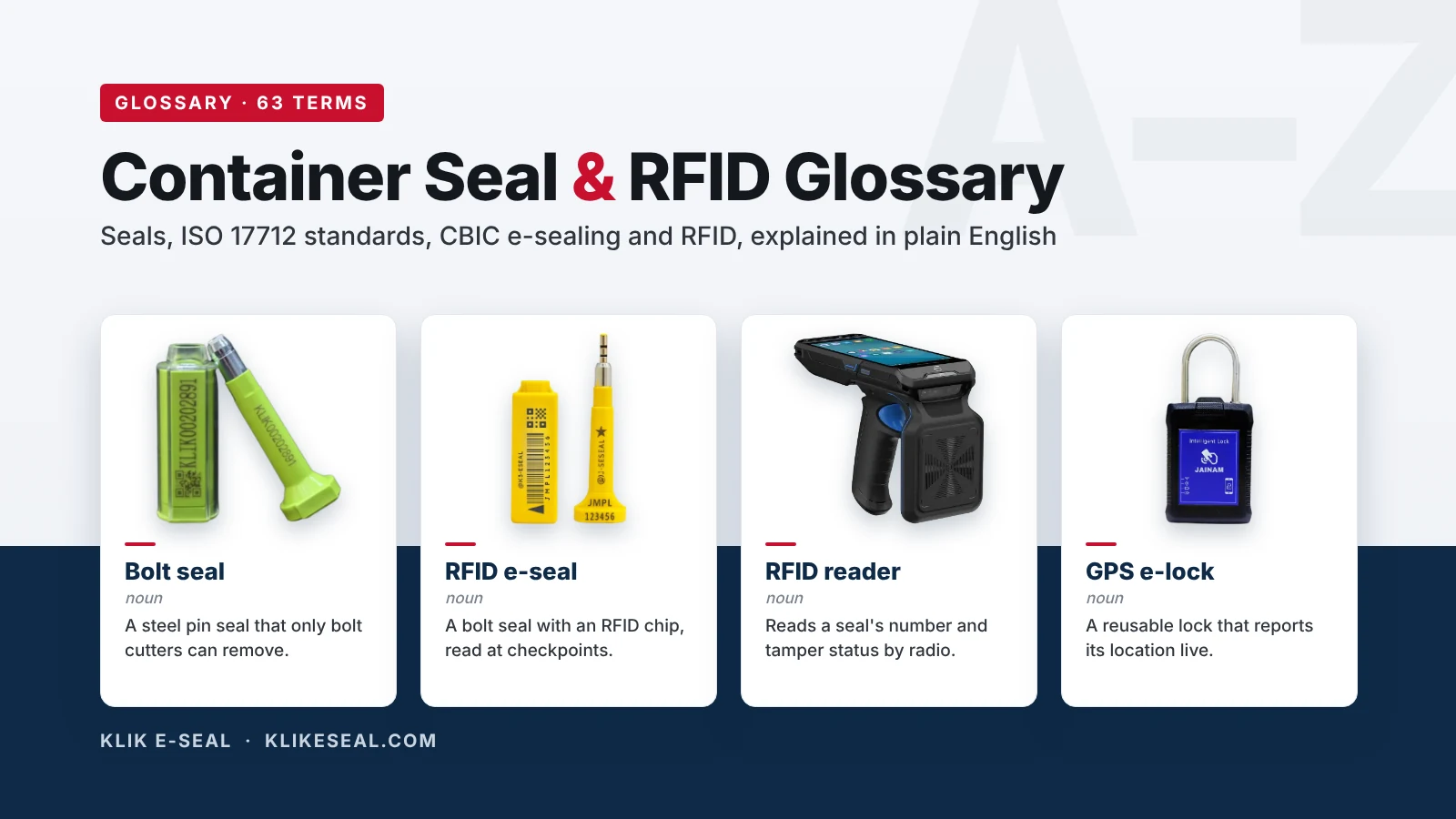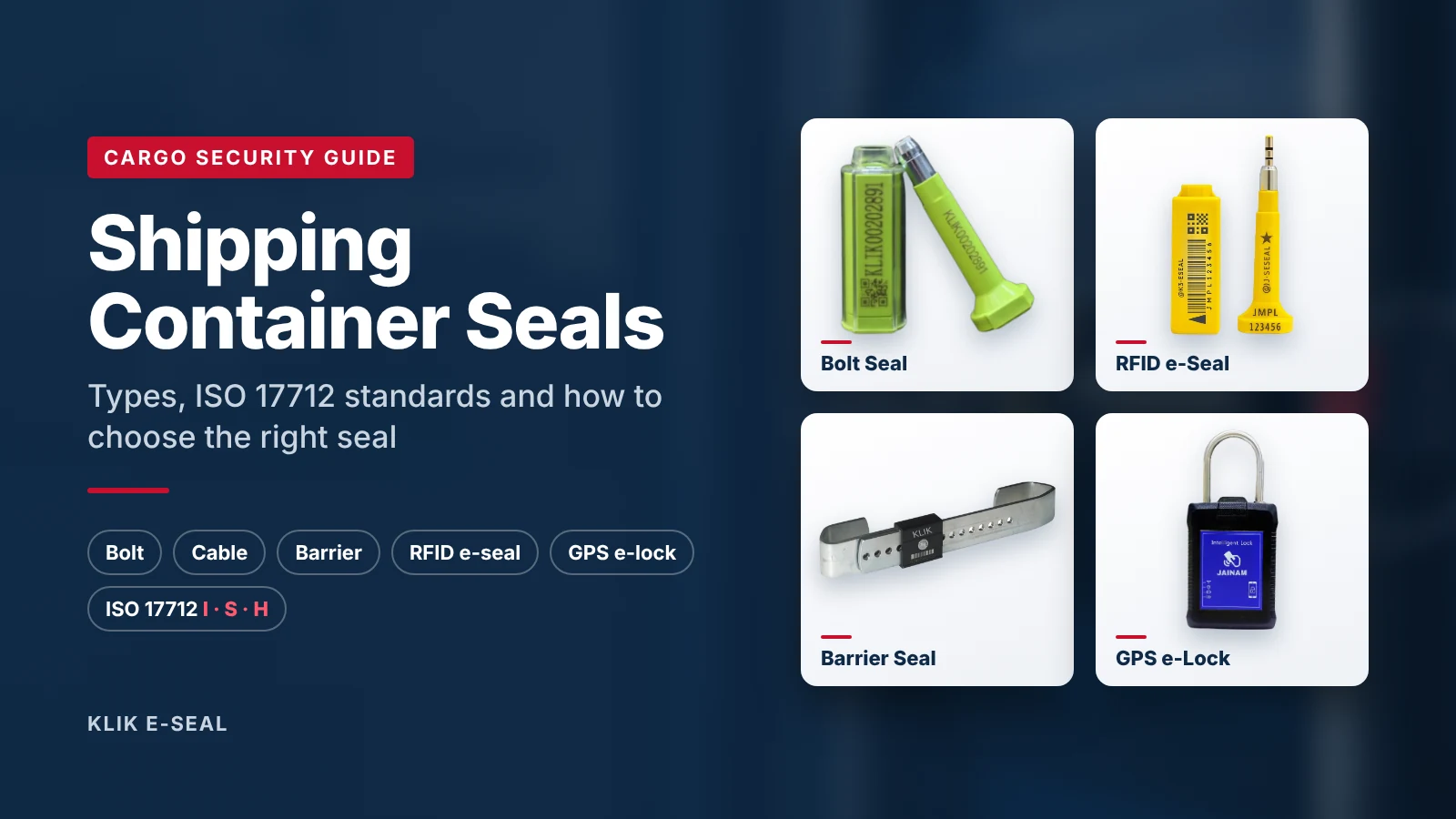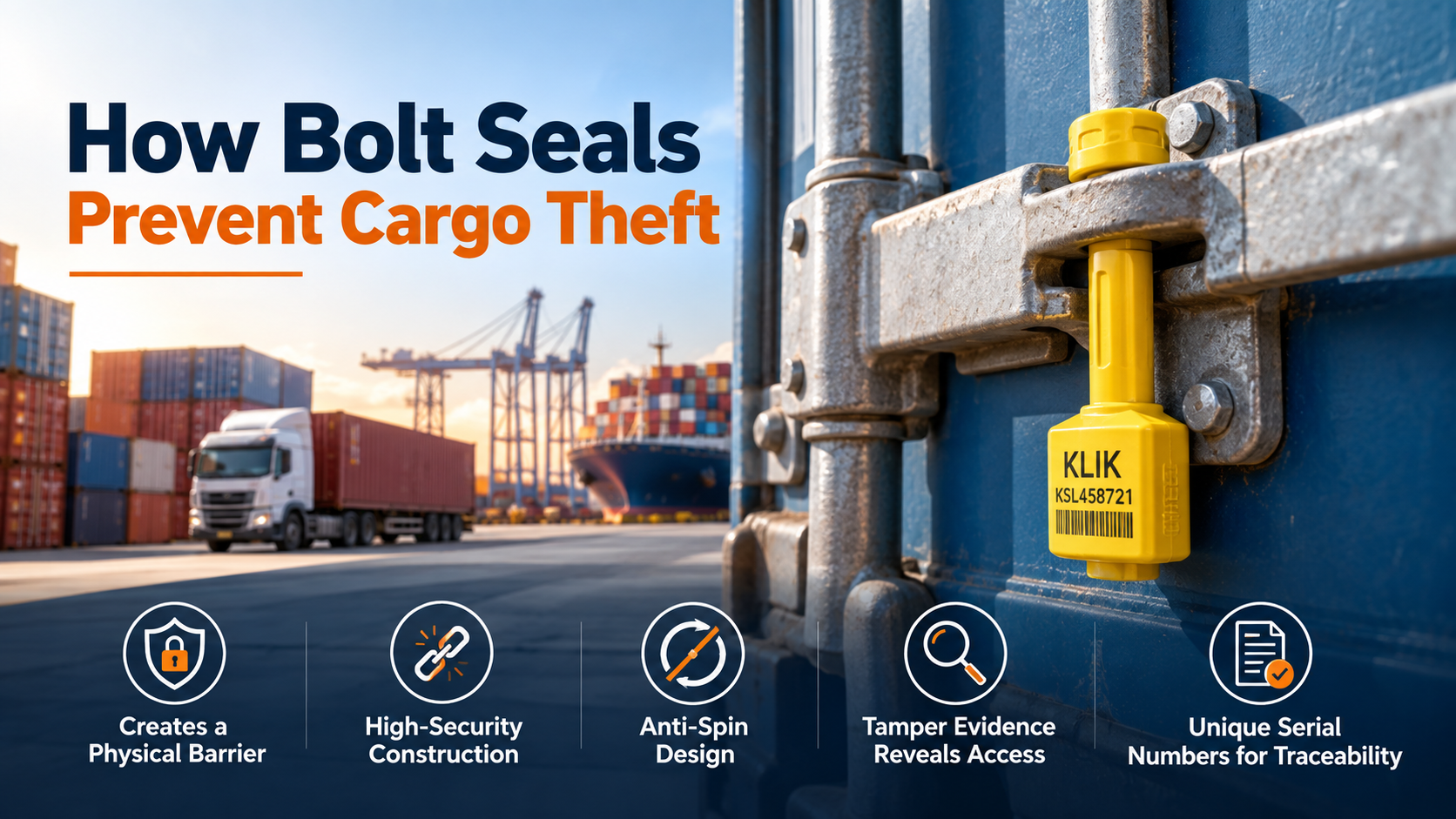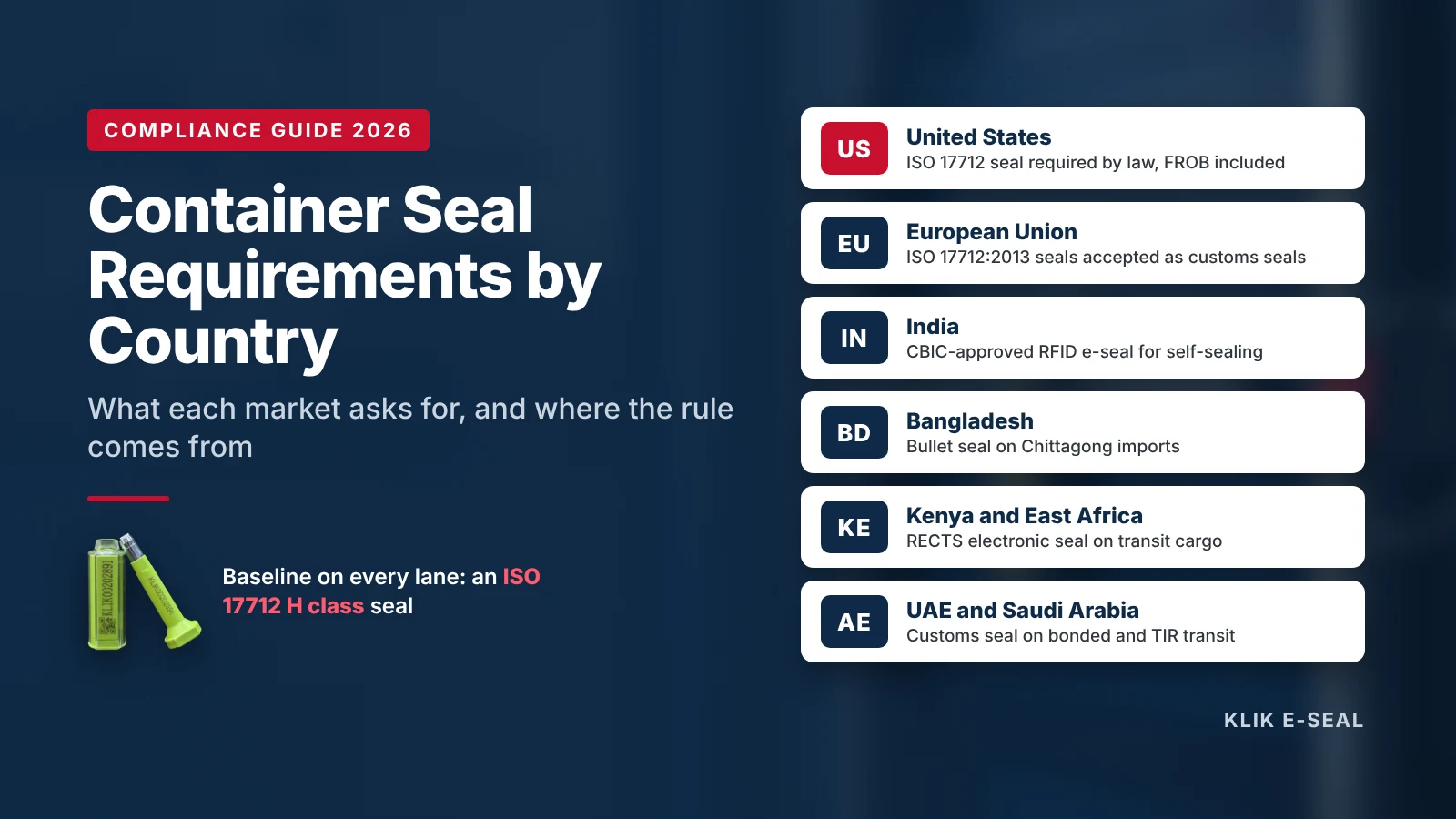

No single global law covers container seals. But almost every loaded export container still needs an ISO 17712 high security (H class) seal. US law requires one on sea containers, and the big shipping lines won’t carry a full box without one.
Some countries then add their own layer. India wants RFID e-seals on self-sealed exports. Chittagong turns away import boxes that don’t have a bullet seal. Kenya tracks transit trucks with electronic seals.
Below is what each major market asks for, who it applies to, and where the rule comes from.
Key Takeaways
- There’s no single global law, but Maersk, MSC, Hapag-Lloyd and ONE all require ISO 17712 high security seals on full containers.
- The US requires a seal meeting ISO 17712 by law on loaded sea containers, including freight remaining on board.
- The EU accepts ISO 17712:2013 certified seals as meeting its customs seal requirements.
- India requires CBIC-approved RFID e-seals for self-sealed exports, and Chittagong requires bullet seals on laden imports.
- Kenya, Uganda and Rwanda track transit cargo with electronic seals under RECTS.
Start With Your Shipping Line
Your carrier’s rules apply before any country’s do, and they’re stricter than most people expect.
| Shipping line | Seal rule |
|---|---|
| Maersk | ISO 17712 high security bolt seal on every container under a Maersk bill of lading |
| MSC | ISO 17712 high security seal on all full containers, fitted by the shipper right after stuffing |
| Hapag-Lloyd | High security seal to the current ISO 17712 on all full containers; costs or fines for an unsealed box can be passed on |
| ONE | ISO 17712:2013 high security seals on all containers for international transit, mandatory for all customers since 2026 |
So even where a country has no seal law, the carrier expects an H class seal. Skip it and you risk a rejected container, a seal fitted at your cost, or liability if there’s a claim.
Quick Reference by Country
| Country or region | What’s required | Who it applies to |
|---|---|---|
| United States | Seal meeting ISO 17712 on loaded sea containers; H class for C-TPAT members | All loaded containers arriving by vessel, including FROB |
| Canada | High security seal on loaded containers and trailers | Partners in Protection (PIP) members |
| Mexico | ISO 17712 high security seals on containers and trailers | OEA (formerly NEEC) certified companies |
| European Union | ISO 17712:2013 certified seals accepted as customs seals | Union transit and authorised consignors |
| India | CBIC-approved RFID e-seal | Exporters using self-sealing |
| Bangladesh | Bullet (bolt) seal on laden import containers | All imports through Chittagong |
| Kenya, Uganda, Rwanda | Electronic cargo tracking seal (RECTS) | Transit and export cargo under customs control |
| UAE and Saudi Arabia | Customs seal on bonded and TIR transit moves | Transit cargo under customs control |
United States
This is the one country where the rule is written into law. Under 6 U.S.C. 944, every loaded container that arrives at a US port by vessel has to carry a seal that meets ISO 17712. It’s been enforced since October 15, 2008.
Two details catch people out. First, it covers freight remaining on board (FROB), so a box that only passes through a US port still needs the seal. Second, CBP’s notice on the container sealing requirement warns of penalties for getting it wrong. Tank containers and open tops, which can’t take a standard seal, are exempt.
A US port call is enough. The US sealing law covers freight remaining on board, so cargo that only passes through a US port still needs an ISO 17712 seal.
C-TPAT members carry extra duties: an H class seal fitted right after stuffing, a seal log, and the VVTT check (View, Verify, Twist, Tug). New to the jargon? Our container seal and RFID glossary covers it.
Canada
Canada’s seal rules sit inside Partners in Protection (PIP), the trusted-trader programme run by the Canada Border Services Agency. For members, a loaded container or trailer must have a high security seal on before it reaches the border.
What CBSA asks PIP members to do:
- Keep the seal maker’s independent lab test report on file.
- Report any seal that’s missing, tampered with, or doesn’t match the paperwork.
If CBSA officers open a load for an exam, they re-seal it with a high security bolt seal.
Mexico
Mexico runs its own trusted-trader scheme, OEA, which used to be called NEEC. It works much like C-TPAT. Certified companies have to use seals that meet or exceed ISO 17712 on containers and trailers moving in foreign trade, and they need written procedures for controlling those seals.
Plenty of Mexican plants also ship north, so in practice they work to both rulebooks on the same lanes.
European Union
The EU doesn’t make ISO 17712 compulsory for every export. What it does is treat it as the benchmark for customs seals. Article 301 of the Union Customs Code implementing regulation (EU) 2015/2447 says seals certified to ISO 17712:2013 by a competent body are deemed to meet the technical requirements.
That matters most in Union transit. A customs seal there carries the word “Customs” in an EU language plus the ISO country code of the member state that fitted it. Authorised consignors can use seals of a special type under Article 317.
India
India goes a step further than most and adds an electronic layer. If you self-seal full containers at your own premises, you must use RFID e-seals bought from a CBIC-approved vendor. The rules sit in CBIC circulars 26/2017, 36/2017 and 41/2017-Customs.
Before the seal goes on, you upload its data through the vendor’s app: IEC, Shipping Bill number and date, e-seal number, sealing date and time, destination customs station, container number and truck number. Customs then reads the seal at the port or ICD. Our guide to CBIC-approved RFID e-seal vendors has the full process, and our RFID bolt seal is made for it.
One recent point worth knowing: a July 2026 instruction to SEZ units noted that shipping line seals don’t replace customs-prescribed sealing unless a procedure specifically recognises them.
Shipping to More Than One of These Markets?
Klik e-Seal makes ISO 17712 high security seals, CBIC-approved RFID e-seals and GPS e-locks, so every lane can be covered by one supplier.
Request a QuoteBangladesh
Shipping into Chittagong? Use a bullet seal. That’s the local name for a bolt seal, and Chittagong Port Authority Circular 17/2021 made it mandatory on all laden import containers from December 1, 2021.
The port can refuse to discharge a box that arrives with only a plastic or metal strip seal. When that happens, carriers bill the shipper for the return freight.
Chittagong can send your container back. Without a bullet seal, the port can refuse discharge and the return freight is billed to the shipper.
There’s a second rule for transit. Under its Electronic Seal and Lock Rules 2024, Bangladesh’s National Board of Revenue requires electronic locks and seals on transit and transshipment goods moving through Chittagong and Mongla ports to India.
Kenya and East Africa
Transit cargo on the Northern Corridor is watched electronically. Kenya, Uganda and Rwanda share the Regional Electronic Cargo Tracking System (RECTS): customs fits an electronic seal at departure, tracks the truck in real time, and removes the seal at destination.
The supply side changed in 2026. The Kenya Revenue Authority moved RECTS to a multi-vendor, user-owned model, so transporters now buy their electronic seals from approved vendors rather than using KRA devices. If your cargo moves through Mombasa, check KRA’s current vendor list first.
UAE and Saudi Arabia
Gulf seal rules mostly kick in when cargo moves under customs control. Dubai Customs seals containers and trucks travelling in bond, and its Shahin system puts electronic smart seals on trucks once they’ve cleared customs. The temporary 2026 transit corridors through Omani ports also run under customs seal all the way to Jebel Ali.
Saudi Arabia is part of the TIR Convention, so international road transit there moves under customs seal. ZATCA automated its TIR procedures at all its customs ports in February 2024.
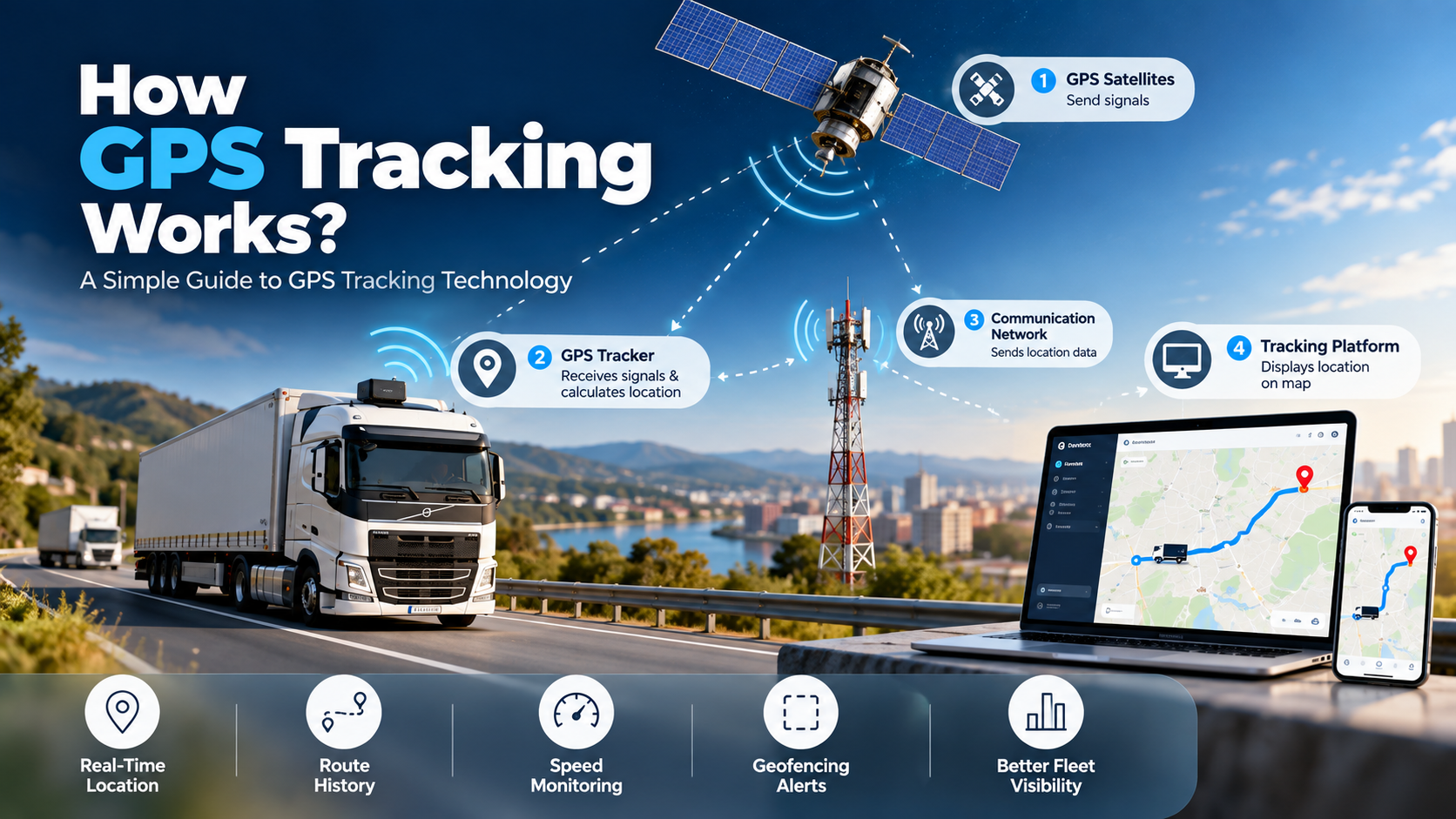
For exports into either country, the carrier’s ISO 17712 rule is still what applies at loading. On long road legs across the GCC, plenty of shippers add a GPS container lock so they can see where the truck is.
How to Stay Compliant on Any Lane
- Carrier rule→
- Route→
- Export rules→
- Test report→
- Seal records
1. Check the carrier first
Read your shipping line’s seal policy. Nearly all of them want an ISO 17712 H class seal on every full container.
2. Then the route
A US port call, even as FROB, brings in US law. Chittagong needs a bullet seal. East African transit needs an approved electronic seal.
3. Then your own export rules
In India, self-sealing exporters need a CBIC-approved RFID e-seal before the box leaves the premises.
4. Get the test report
Ask for the ISO 17712 lab report for the exact seal model you’re buying. A quality certificate on its own doesn’t prove the seal is H class.
5. Record every seal
Put the number on the bill of lading, photograph the sealed doors, and check it again at destination. Damaged on the way? Our guide to a damaged container seal during transit walks you through it.
Seals for Every Lane From One Supplier
We design and make security seals in India for exporters, forwarders and shipping lines around the world. Our high security seals are made to ISO 17712:2013. We’re also a CBIC-approved RFID e-seal vendor for Indian exporters, and our GPS e-locks cover road legs that need live tracking.
Send us your lanes and monthly volume and we’ll match each one to the right seal. Request a quote.
Frequently Asked Questions
Is an ISO 17712 seal required by law in every country?
No. The US requires it by law for loaded sea containers, and the EU accepts ISO 17712:2013 seals as meeting its customs seal specifications. Elsewhere, the requirement mostly comes from carriers and trusted-trader programmes such as C-TPAT, PIP and OEA.
Do empty containers need a seal for the United States?
The US sealing law applies to loaded containers. Tank containers, open tops and other boxes that can’t take a standard seal are also outside the statutory requirement.
Does cargo passing through a US port need a US-compliant seal?
Yes. The requirement covers freight remaining on board (FROB) that arrives at a US port by vessel, even if the US isn’t the final destination.
Which countries require electronic container seals?
India requires CBIC-approved RFID e-seals for self-sealed exports. Kenya, Uganda and Rwanda use electronic tracking seals for transit cargo, and Bangladesh requires electronic locks and seals for transit and transshipment goods to India.
What happens if a container arrives without the right seal?
It depends on the port and the carrier. Chittagong can refuse to discharge an import container without a bullet seal, US Customs can assess penalties under its sealing law, and carriers can reject the container or charge for re-sealing.
Final Thoughts
The rules look different country by country, but they all sit on one base: an ISO 17712 H class seal, fitted right after stuffing and written on the bill of lading. Get that right and you’ve covered your carrier and most customs authorities in one go.
Where lanes really differ is electronic seals and local port orders, and those change far more often than the standard does. Check them before the first shipment on any new lane. Still deciding which seal to buy? Our guide to shipping container seals types, standards and how to choose is the place to start.